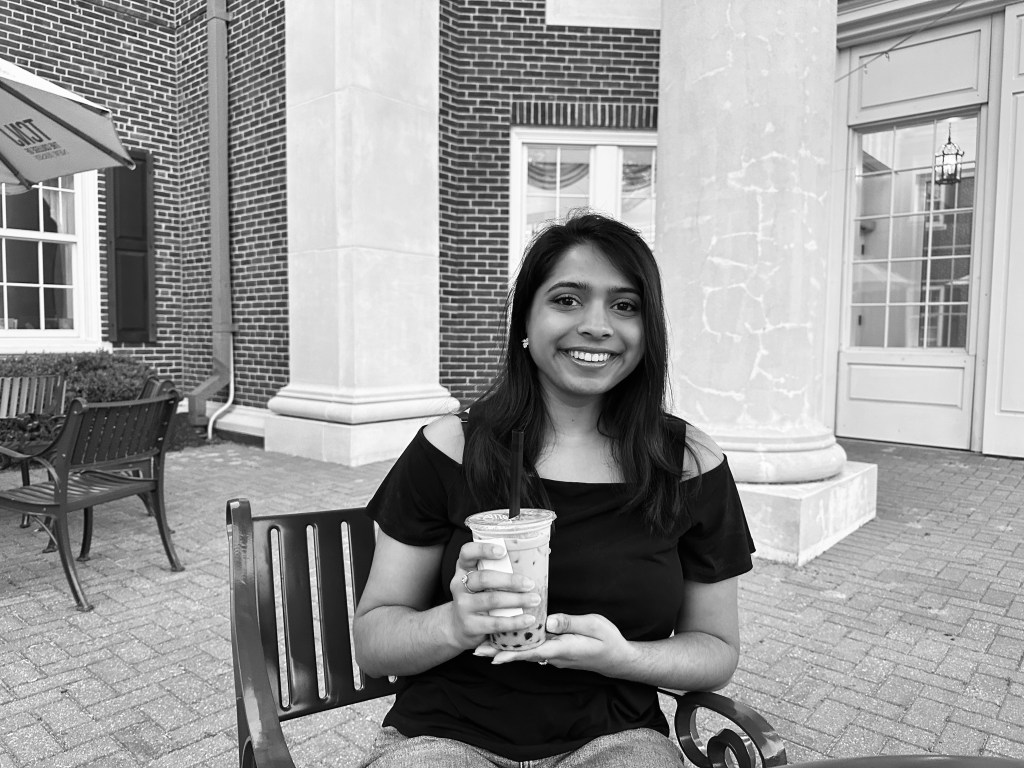
coffee date #48 with hiral solanki
the-mother-of-the-clan, ed + psych major, jägerbomb lover, my-spending-buddy-whenever-we-go-out, ‘let’s take a shot,’ an active listener, an empathic witness, wine buddy, “hotel motel” fan, fellow-spontaneous-adventure-seeking-buddy
me: pearl milk tea w/ boba | hiral: taro milk tea w/ boba
location: trenton hall, the college of new jersey
We all have that one friend who looks after everyone at a party, books the ubers, worries about everyone’s well being, is everyone’s therapist, offers food every time we visit, and is overall, ‘the mother’ of the clan.
This is Hiral Solanki.
I met Hiral through the college dance team and instantly recognized that she’s a precious soul. She has this incredible ability to listen. Listening is such an underrated skill. It involves a tremendous amount of attention and compassion to create a space for others to speak and share their feelings. Hiral nails this skill and instantly created a space like that for me.
Hiral is also one of the two people (the other person was coffee date #37) that I went on my first ever girls trip with. I remember Hiral texted me over spring break when I was at Bal Ashram. I skimmed over the text asking “Wanna go to North Carolina with me for the DDN competition?” I immediately said yes despite not really knowing much about the DDN world because the idea of traveling out-of-state and living it up with a friend hyped me up more. Our dads finessed our flight tickets and hotel reservation, and the following month, the 3 of us flew to North Carolina and had an epic weekend.
I realized very early on that I need a Hiral in my life – someone who always gives in to my intrusive thoughts, who is always ready to take another shot, and most importantly, someone who is always present.
Diving into the world of Hiral Solanki….
Epiphanies
- the grad feels.
During the last month or so of my junior year, I deepened my relationship with a few seniors, who graduated the following month 🥺 While spending a whole bunch of time with them, I listened as many of them reflected on their college lives and who they will keep in their lives post-graduation. It felt bittersweet to listen to and engage in these conversations because I knew that I would be in their position next year.
Hiral is someone who I’ve talked to a lot about these feelings of ‘weirdness’ post-college because college provided us both with a safe space, consisting of incredibly wholesome people.
Hiral described that in college, everyone is ‘within the palm of your hands.’ It’s so easy and almost effortless to grab food or a coffee with someone because we’re all here! What about after college? What happens to these friends?
There was this post I saw somewhere that said something along the lines of how when we find ‘our people,’ we kinda fall in love with them a little – the platonic kind of love. We learn to love their laughs, the memories, their unique sense of self, their likes/dislikes.
Thus, losing such connections with people (which is completely okay because not all relationships are meant for the long-term!) can feel hard. Such feelings should be normalized so that we’re prepared for them once we move on to the next chapter of our lives.
- boundaries with our parents.
When we talk boundaries, we often talk about them in regards to friends or significant others. I believe, though, that boundaries should also be enforced when it comes to our parents. After all, parents are also people, so our relationship with our parents also require us to treat it similar to any of our other relationships. Note: The levels of boundaries will differ based on the level of connection and safety one feels with their parents/guardians.
“I was a Code Blue. I was a problem since I was born!” – Hiral Solanki, 2023
Hiral and I agreed that our parents tend to overstep our boundaries when they sense that they are losing control. I get it that sometimes it is scary to see your kids doing their own thing, failing at life, and potentially making bad choices (or choices that you would make differently). However, them trying to regain control by becoming overbearing or further controlling can make us feel like we are losing control of our own lives. Therefore, boundaries can act as the solution.
One boundary that I found has helped me is communicating with my parents that I will tell them about my life decisions once I, myself, have come to a conclusion. I made it clear that I will not include them in the brainstorming process unless I decide that I need some help from them. It sounds harsh, but for me, personally, I found that telling them things about my life after-the-fact has helped alleviate a lot of the stress that used to come with them micro-managing things when I involved them during the process. For example, if I told them that I wanted to work as a medical scribe, they would then constantly ask me if I applied for jobs, where I am applying, is it worth it, etc. Conversely, if I just tell them that I got a job as a scribe after I actually do get a job, then they will be equally happy and accepting while also saving me the mental turmoil of their micromanagement/anxiety.
I understand that some parents are more understanding than others, so some might need firmer boundaries, such as no-contact, than others, and that’s okay. Normalize treating our parents as people and not placing them on these pedestals to the point where we think that we have to give up control on our own lives for them. We can be grateful to them while also being our own individual people with our own set of needs.
- money.
Hiral is usually the person who will be at the bar, paying for everyone’s drinks, or the person booking all the Ubers, or the person who will spend an x amount of money for some event.
We share a similar mindset when it comes to money.
“This isn’t going to be happening again. We’re living in the moment.” – Hiral Solanki, 2023
For Hiral and I, we value time more than we value money. Obviously, we value money to the degree of not spending it aimlessly for absolutely no reason. But if we’re out & about and creating memories, then we don’t mind spending it.
Here’s a little blurb that kinda explains what I’m trying to explain LOL:
“I began to understand that spending money can be OK, especially when it’s with loved ones or for things that truly make your life, living space, job, relationships, health or general existence better. I will always thank my amazing mom for teaching me how to save because surely that is a harder skill to learn than how to spend. But I am also thankful that I’ve learned that money is made to be spent, and I should be happy when I spend it in the right places.” – Source
I understand that this is mostly true for those of us who come from privileged backgrounds, where we have enough financial security to even be able to think about spending money for the purpose of just living life versus others who may not have the same option.
- the bucket list life.
Hiral has this epically wholesome bucket list that she created during the pandemic.
Her reason for creating the bucket list was similar to my reason for creating this fifty coffees project 🥺Hiral explained that she realized that she never appreciated the little moments of what she had before the pandemic. Thus, creating a bucket list of things (that aren’t all necessarily big life-changing tasks like sky diving) reminds her of all of those little things. Going through the things on this bucket list inevitably increases her feeling of gratitude, which we know has many research-backed reasons for increasing one’s happiness and emotional well being.

 Esha Kode