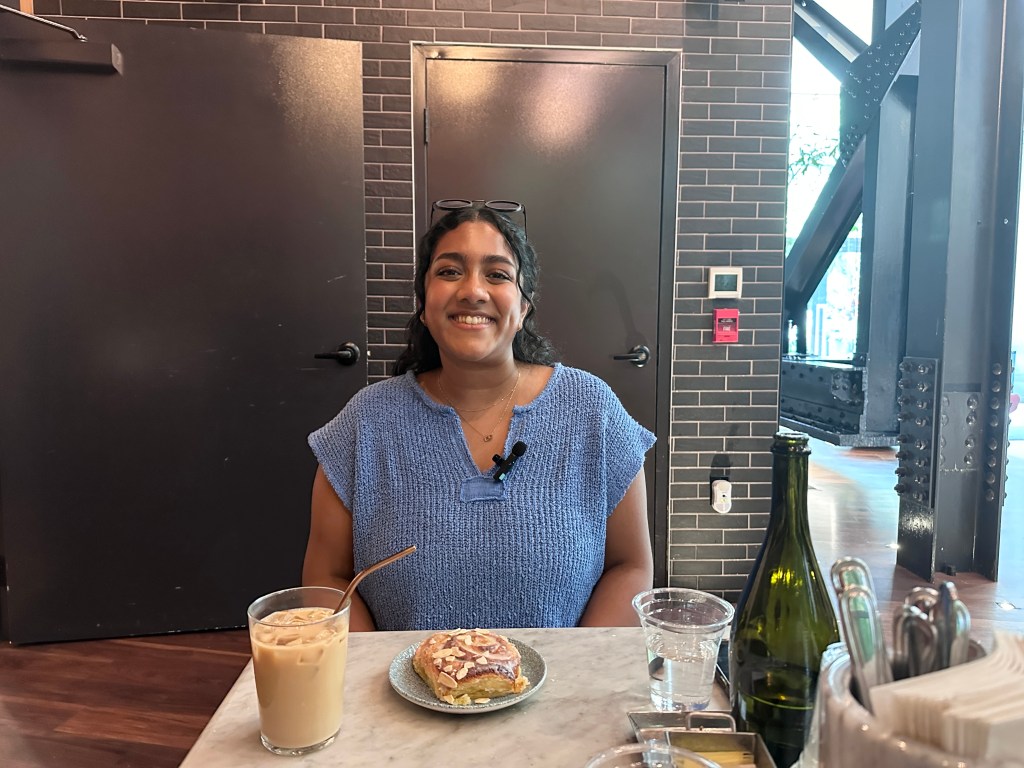
coffee date #54 with lekha koneru
soy milk aficionado, café hunter, UPitt alum, med school bound, professional parallel parker, perugu anam fan, skincare guru, part of the Koneru long lashes club
me: orange blossom latte w/ oat milk | lekha: yemenite latte w/ oat milk
location: K’Far, pennsylvania
I’ve known Lekha for quite literally my whole 22 years of existence. We’ve danced obnoxiously in bedrooms, cackled like clowns at all times, had many sleepovers on end, and somehow have miraculously managed to survive through the toxic biweekly, if not weekly, family get-togethers.
Throughout our relationship, Lekha has always maintained a certain unwavering warmth. She always greets me with a cute little wave followed by a “hi papa!” and a dimpled smile that travels all the way to her eyes. Lekha’s hugs, similar to coffee date #21‘s, are also filled with loads of love and comfort. So you can see why I’m so extremely excited for this date.
Diving into the world of Lekha Koneru ….
Epiphanies
- the importance of childhood
Lekha and I spent majority of the date talking about our childhood. Thus, I’ve broken up the subsequent parts of the date into different aspects of childhood we covered in further bullets below. Before diving into the nitty-gritty, I wanted to take a minute to emphasize and SCREAM about the importance of our childhood because Lekha and I both felt that childhood is such an underrated and disregarded time period even though it may very well be the most important period of our lives. So, here it goes…
In the words of my therapist, “Children are like sponges. They absorb everything around them.” Everything that a child experiences from the age of 0 to about 6-7 directly impacts their adulthood lives. If you don’t believe me, search it up. Dr. Gabor Maté is a pioneer in this field and has some exceptional resources to check out.
“I don’t think a lot of people understand how literally a single phrase can affect a child and basically be with them for the rest of their life.” – Lekha Koneru, 2024
Allow me to provide a non-exhaustive list of examples of certain situations created by adults in children’s lives and how children tend to absorb, internalize, and interpret those situations. Note: These are just possibilities. I’m not claiming that these are definite situations for every child.
Situation
- Dad is always working and is never home.
- Mom likes it when I look skinny.
- I was put in time-out for being sad and angry.
- My dad hit me after she found out that I told an adult a secret.
- Mom only feeds me if I’ve been a good girl today.
Interpretation
- He must not like me. I am not good enough for him.
- Mom only loves me when I look a certain way.
- Never let people know when you’re sad or angry. Hide it.
- I can never trust anyone again.
- Food is either a reward or a punishment.
Adulthood Result
- Imposter syndrome. Borderline personality disorder. Narcissism.
- Eating disorders. Body dysmorphia.
- May lead to a plethora of health conditions due to the active suppression of emotions.
- Commitment issues in relationships.
- Addictions: alcoholism, drug abuse, smoking. Eating disorders.
Takeaway message: Every psychological and physical problem that we face now as adults can be traced back to our childhood experiences.
Thus, we need to pay more attention to our children. We also need to put more effort into working on ourselves to ensure that we raise children in safe, loving, and nurturing environments.
- childhood: unconditional love
Lekha and I admit that our parents must have attempted to raise us in the way they knew best. However, the key thing that both our parents slacked on was providing unconditional love. I’m sure they thought they were giving us enormous amounts of love, but majority of that love came tangled with certain rules and regulations.
I will love you more if you lose weight.
I will love you if you take care of the people in the house.
I will love you if you always promise to ‘smile and be happy.’
I will love you if you never talk back.
Dr. Gabor Maté, my 80-year-old pretend grandpa, always says that if a child was never loved for simply existing, then any other sort of love you give them is conditional love. In other words, unconditional love is not dependent on one’s achievements, appearance, goals, or capabilities. Unconditional love is loving someone for simply being and for existing.
It may come naturally for some, while others of us may have to put a bit more work into detaching love from materialistic and superficial ideas. But hopefully we can all attempt to both provide and accept such kind of love because we all deserve it.
- childhood: face masks & emotional suppression
Our childhood experiences shape our adulthood selves. I’ll say that again. Our childhood experiences shape our adulthood selves.
Listen to a snippet of our conversation below before reading further:
Whatever masks we are forced to wear during our childhood will inevitably follow us into our adulthood. Lekha shared some of her masks that she was told to wear as a child in order to be accepted by the people around her. The first two words I always think of when describing Lekha are “kind” and “funny,” so it came as a bit of a shock when Lekha explained that these were the very masks that she wore for years trying to please those around her. In essence, Lekha was made to believe that her entire value and worth as a person was dependent on her ability to show kindness and make people laugh. Imagine how much pressure that places on such a young girl, who was forced to place other’s needs in front of her own.
Thus, as Lekha mentioned in the recording, if she were to feel anything other than kindness, she’d think that she was a terrible person. It was only last year, after my visit to Bal Ashram and chatting with coffee date #44, that I realized that there is no such thing as good and bad. No such thing. Being human means living in the grey and feeling comfortable and safe enough to live in the grey. Where does that safety come from? Our connections with people from our childhood. Lekha shared that she was only able to realize this after her therapist told her that there is absolutely nothing wrong with not being able to be kind all the time, especially when she was never given the space to be anything else.
- childhood: how should we praise children?
I read something somewhere once that talked about how we should approach praise when speaking to children. When we praise specific talents, skills, or even characteristics of their personality, we convey to them that those specific parts of them hold greater value than the rest of them. This causes children to internalize those compliments and comments from adults, which may have been said with good intentions, to the point where they continue to elevate those aspects of themselves while suppressing the rest of themselves. You can see why this is not a very efficient way of raising emotionally mature children.
What we should actually be praising our children for, in my very unexperienced opinion, is their ability to be human – their ability to navigate a very tumultuous world by tapping into every part of themselves. Lekha and I are fans of the new Inside Out movie and think that this point is well made in that film. So go watch it and be prepared for a heart-fuzzy ending.
So every time Lekha was praised for her kindness, she was also inadvertently told that she can only be kind and happy – all the other very human and natural emotions, such as sadness and anger, must be suppressed. And what happens when we suppress our natural emotions? We induce more trauma that quite literally becomes embedded in our bodies and can later manifest as autoimmune conditions, eating disorders, cancers, arthritis, and much more.
- childhood: body image
We inarguably live in a fatphobic world. Despite all the “plus size inclusivity,” we still equate being fat to being less than. It’s astonishing to see just how deeply that is ingrained in all of our brains.
Lekha and I related on how much we were commented on our bodies and food as children at those regular family parties.
Before even a “Hello, how are you?” these uncles, aunties, and even grandpas and grandmas would say “Oh looks like you’ve gained weight ah?”, “Why are you eating so little?”, “You shouldn’t eat so much naan.”, “Looks like you’ve stopped working out.”, “Why do you look so bloated?” I can go on and on.
There’s so much I want to say.
Firstly, why do you adults even feel the need to bring up one’s weight? Truly, what are you gaining out of that conversation? Absolutely nothing.
Secondly, it’s even more shocking to me when I hear the grannies and grandpas making these comments. These people are quite literally in their 60s, 70s, and even 80s. So even after having lived through so much and so many years, they’re still so engrossed in the idea of weight.
Thirdly, what happens when we make such brutal remarks to children about their weight? You guessed it. They carry these remarks into their adulthood to the point where they too become so engrossed with their weight, which, if taken too far, can manifest into a variety of eating disorders, weight issues, hormonal problems, and so much more.
So, dear parents, guardians, caretakers, grandmas and grandpas, and all you other adults:
Why do we want children to grow up into adults who never get to be grateful for all the amazing things our bodies already do for us??? Quite literally every day, our bodies help us breathe, pump blood, fight off infections, heal on its own, and even dream big dreams. How freaking incredible is that? This is what we’re supposed to teach children about their bodies.
Why do we want children to grow up into adults who never get to enjoy food for its taste along with its nutritional, social, and soul-filling benefits? Food is not meant to be a reward or a punishment. Our bodies know best. We should be able to listen to our bodies and feed them what they want and crave. We shouldn’t have to worry about calories, compensating in the gym, or gaining weight.
Our bodies are so much more than the way they look and the sooner we learn to heal our own associated traumas with our bodies, the sooner we can raise children to love their bodies and themselves unconditionally.
- a quick little reminder that anxiety looks and feels different for everyone
The one common anxious symptom Lekha and I both seemed to share is that we’re simply never relaxed, inside or outside our homes. Other than that, our anxieties vary greatly.
My anxiety largely stems from productivity, while Lekha’s anxiety is mainly intertwined with her relationship to food and her body. After Lekha talked me through her own anxiety journey, it became more clear just how uniquely anxiety can affect people.
- therapy
I asked Lekha to describe to me how therapy has helped her and continues to help her.
She started by saying that the validation that she receives from her therapist is one of the biggest things that helps her every session. There’s just something about having an unbiased random person whose sole purpose is to listen to you without judgement and hold space for your deepest feelings 🥺☺️
“You don’t always have to improve on yourself. You can just get to a point where you can simply exist.” – Lekha Koneru, 2024
Lekha also shared that her therapist helped her understand that healing does not mean we have to constantly “be better.” In fact, healing essentially means giving ourselves enough grace to just be ♥️
 Esha Kode