
coffee date #58 with sreeya kavuri
1/5 of the ‘CBT Support Group,’ future doc, baker, EMT, reader, horror movie lover, self-diagnosed-amnesiac, once-upon-a-time-matcha-enthusiast
me: puchakai juice | sreeya: puchakai juice
Sreeya is well…Sreeya. The cutie in yellow (see below).
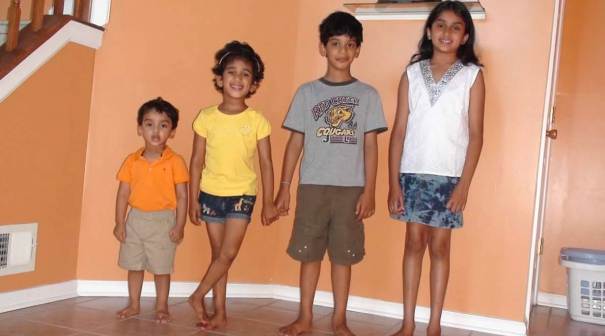
I was a total of 4 years old when Sreeya was born. She was a cutie baby, who was, unfortunately, immediately getting bullied by Suhas Kavuri (Su, coffee date????? 👀). At times, I was tasked with applying the thick Aquaphor cream all over her tiny body for her eczema; she’d twist and turn, distracted by the objects around her. Other times, I was on feeding rasam duty and I’d watch her completely dissolve into the TV forgetting to chew. And of course, there was the time when we had a sleepover and she straight up smacked me in her sleep with absolutely no recollection of it the following morning. Good times.
Sreeya is one-of-a-kind. The kind who ran headfirst into the pole in my basement. The kind who physically bruises your arm while watching a horror film. The kind you can never tell if she likes you or hates you (although, Sreeya is incapable of hatred). She’s the most matter-of-fact person I’ve ever met. But Sreeya is also the most empathetic, calming, and understanding person I know; she really truly understands and sees people.
This coffee date felt like a breath of fresh air; it was fun, airy, and heartwarming to listen to this once-upon-a-time baby share all her wisdom with me 🥺.
“I don’t have wisdom.” – Sreeya Kavuri, 2025
Diving into the world of Sreeya Kavuri …..
Epiphanies
- rage and anger
First off, both Sreeya and I both feel an uncontrollable amount of rage when we’re walking behind or with slow walkers. Our walking paces are much faster compared to the rest of our family members; thus, most of the time, when the CBT Support Group goes on useless walks, it’s me and Sreeya at the front and the remaining three (coffee dates #5, #13, and Suhas Kavuri) meters behind us.
Sreeya also shared that she generally views anger as an invitation to learn more about her feelings.
“That anger doesn’t really leave. It just helps you find better ways to get out of it.” – Sreeya Kavuri, 2025
As I learned from coffee date #49, anger is often a secondary emotion; there’s usually a deeper root cause (ie, neglect, pain, abandonment). We chastise and label people as being too angry, but when we shift from viewing anger so one dimensionally to more holistically, we can form a more empathetic community (which Sreeya is a champion of).
- thoughts we should all be thinking
I must say Sreeya’s prefrontal cortex works overtime with the many thoughts a day that she manages to think. She used to have a page in her Notes app dedicated to all her intrusive thoughts. When I say intrusive thoughts, I don’t mean thoughtful, introspective, existential questions. I mean questions like, “What happens to the Halloween costume store during the year?” or “Who wore jeans for the first time?”
I’d argue that I learned how to think intrusively and wildly from Sreeya. She regularly asks these questions to her friends and family to engage in a “meaningful, thought-provoking” conversation, such as the one shown above. It makes for great debate and equally great comedy.
“I just think about them when I’m bored. Sometimes I ask people and they introspect with me.” – Sreeya Kavuri, 2025
- should your partner prioritize you or your children?
As someone who wants children and a spouse in the far future, I’ve always wondered what’ll happen to my relationship with my spouse once we have kids. Will our love for each other change?
“I don’t think they should feel the need to prioritize one over the other because I think the spouse and the children should all be equal.” – Sreeya Kavuri, 2025
Sreeya explained that there really shouldn’t be a comparison at all. The spouse and the children should all get equal amounts of your love and there’s really no need to give more to one vs the other. In terms of care, obviously the children will require more especially in their early years. But love? There’s enough love to go around to nurture the parent-child relationship as well as the spousal relationship.
I guess this is where parental support comes in. When parents have enough support to raise their children, they’re also allowed to care for themselves and continue to work on their own relationship with each other.
- raising children
I asked Sreeya how she thinks we should be raising children. She described the importance of modeling good behavior. Parenting is no joke; it’s stressful, tiring, and sometimes even boring. But Sreeya mentioned the importance of allowing children to see your flaws and then navigating those flaws in a healthy way.
“When people do yell at their children, they shouldn’t just stay mad at them cause they’re children – they don’t know better.” – Sreeya Kavuri, 2025
For instance, if a parent makes a mistake, Sreeya states it’s important that they own up to it and apologize for that mistake (sometimes even when it’s not their fault). Because this will teach the child the importance of acceptance, forgiveness, and honesty.
“We should be there for them but also give them room to grow on their own.” – Sreeya Kavuri, 2025
- love, what do we think it should feel like?
“You shouldn’t feel like you have to recharge when you’re with them. You should be able to go to them to recharge.” – Sreeya Kavuri, 2025
 Esha Kode