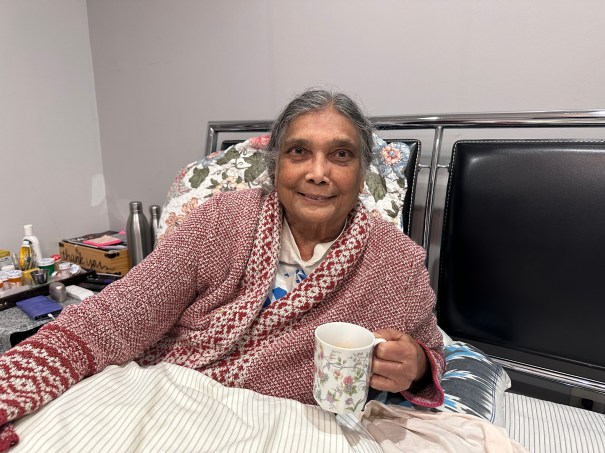
coffee date #59 with umadevi kode
a pretty woke 79-year-old, ninth grade graduate, fashionista, avid learner, professional chef, beauty hacker, Instagram and Facebook legend, Rawanpudi native
me: homemade chai | nani: homemade chai
location: home 🏡
For many people, grandparents are an escape from home. Grandparents are the ones who spoil you with presents, feed you until you can’t eat anymore, and shower you with an unimaginable amount of love. Maybe that’s why most people never take them for granted.
For me, Nani has always been more than someone I visit during vacations or breaks. She’s always been there, from the day I was born. My primary caretaker for a large chunk of my childhood while my parents were working. When I think of my childhood memories with Nani, I think of warmth.
I loved being fed. She’d mix the chicken curry with rice and too much ghee and feed me with her hands. My mouth would water in between each muddha because oh my lord, this woman knows how to cook. I loved sleeping next to her at night, her hand resting on my stomach as she gently patted me to sleep. I felt safe. Comforted.
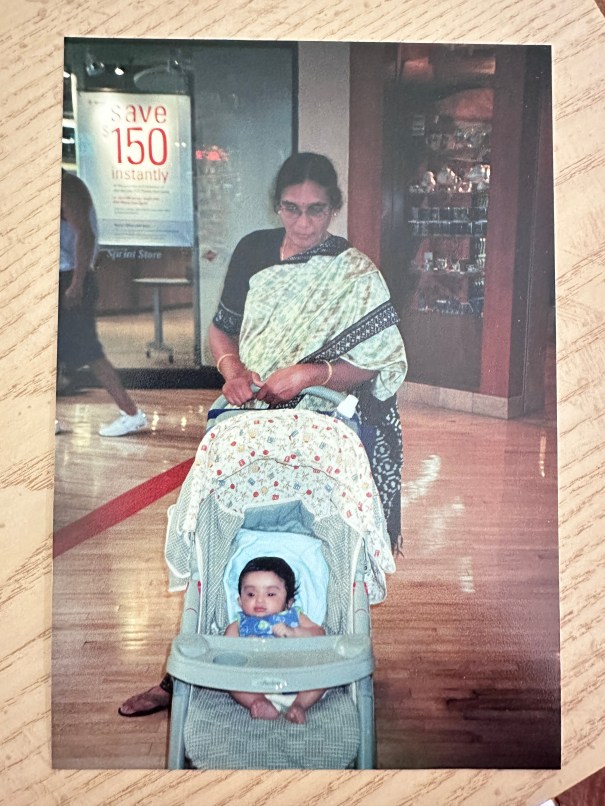
Once, at the park, Nani was pushing me on the swing. A little girl, the same age as I was, came up to me and said hi. I, with the confidence of a five-year-old, proudly introduced us: “I’m Esha and this is my Nani.” The American family smiled and nodded in response, obviously assuming that Nani was my nanny. After they left, Nani said to me, “Esha amma, I’m not your nanny. In English, they say grandma.” We chuckled together.
Over the years, I can’t say that I’ve always viewed Nani with the same warmth or light. We had good days and bad days; however, as I’m seeing Nani age, I’m learning to let go, in my own way and at my own pace.
So I guess this coffee date is somewhat selfish. Maybe it’s my way of managing the guilt of having been angry for so long. But perhaps it’s also a way to reclaim some of the time we lost. A way for me to permanently etch our conversation onto this digital platform so I can always look back and remember the warmth that Nani radiates.
Diving into the world of Nani ….
Epiphanies
- Nani’s childhood
Nani was born in 1946 at American Hospital (lol) in Vijayawada, the second of four siblings (three girls and one boy).
When Nani described her childhood, she said it was “simple” and “routine” – nothing out of the ordinary. But as she talked about her childhood, I couldn’t help but feel that her childhood was anything but ordinary.
Her father (and his father, grandfather, and great grandfather) were all farmers, who gradually accumulated wealth throughout the generations. Nani lived in a manduva house (literally my dream home!) in Rawanpudi, India. Her home was surrounded by vast land and a massive gate. No neighbors. Just them and the workers who helped with the housework and estate.
Nani described that she went to school until she was eleven years old, after which she was no longer allowed to leave her home. Why?
She casually stated, “I don’t know. Once the girls hit 11, they weren’t allowed to leave anymore. It’s just the way it was.” To ensure their daughters would still receive an education, Nani’s father hired private tutors who’d tutor the girls at home.
- “What were you like as a child, Nani?”
Nani was very much loved by her parents, more specifically, her father. She had this warm twinkle in her eyes as she recalled memories with her father.
She described herself as a skinny, light-skinned girl who loved the attention of the many guests who visited their home. One of her favorite memories was playing with her aunt’s daughter, with whom she’d run around, cut flowers off of trees, and present them to anyone they met. Perhaps this is where her love for flowers came from?
- The God of Small Things
When Nani mentioned that she had no neighbors, I wondered if that meant her family home stood alone in the entire village. She laughed softly and said, “No no,” pausing to find the right words to explain.
“Others lived around us,” she explained, “but they were from a lower caste. I wasn’t allowed to go beyond the compound wall of our house for this reason. If we wanted to go to a cinema, my dad would arrange for a car and would make sure my uncle came with us.”
She continued, almost matter-of-factly, “Those living around us wouldn’t enter our home and I wasn’t allowed to enter theirs or even interact with them.”
I took a breath. I knew that the caste system was (and still is) very real, but hearing Nani living through such a time felt different. She knew that she was different from the children living outside of the walls. She remained inside; they remained outside. No questions asked.
As Nani spoke, I was reminded of Estha and Rahel from Arundhati Roy’s The God of Small Things. Based in Kerala, the novel explores the impact of the caste system on a multigenerational family’s ability to love and live. Estha and Rahel, like Nani, knew that they were different from Velutha, a lower-caste man. But unlike Nani, Estha and Rahel were curious, less controlled, and managed to interact and even love Velutha. Still, for all three children, I feel like societal norms and cultural notions dampened their ability to actually love, explore, and live life fully.
Nani didn’t agree with me. She said that not leaving her home didn’t really affect her childhood because “It’s all I’ve ever known. All of my sisters and I were told the same thing, and we made time pass at home. My brother was the only one who was allowed to go out and do whatever he wanted to do. But still, my sisters and I never cared.”
- My great grandparents
Nani’s mother was supposedly a fashionista (perhaps that’s where Nani gets it from). She loved doing hair and experimenting new braids for her daughters. She loved her jewelry (perhaps that’s where Arya gets it from?) and making food. Nani’s father was a farmer, so think of the village heads in those rural Telugu movies. Whenever he’d return from trips, he’d bring his children a ton of toys, spoiling them endearingly.
- Menstruation during the 1950s
Nani never received “the talk” before her period (I mean neither did I, but Mr. Google answered all I needed to know). Once she got her period, her mother just told her what to do.
She was to use a cloth to absorb the blood, change it every few hours, and leave the dirty ones for the workers to wash and bring back the next day. The idea of having others clean something so personal and vulnerable felt strange and almost dehumanizing to me.
During their periods, the girls were told to stay in one room of the house. They were not allowed to leave that room. Most importantly, they were not allowed to enter the kitchen or the prayer room.
It’s interesting and even heartening to see how far Nani has come since then. Now, when I get my period, there’s no more hush-hush or secrecy. In fact, she’s the one providing me with the heat packs. Although I’m still not allowed to touch any godly things or enter the prayer room, I do have the freedom to do whatever I want. If I run out of pads, Nani will hand me the pads without a second thought.
There is no shame in menstruation anymore. I don’t know if this was an easy thing for her to unlearn, but she did excel at it exceptionally.
- A love for learning
I’ve seen Nani fight with the lawn mower guys to make sure they cut the grass properly. I’ve also seen her greet, sign for, and converse with the UPS and Amazon workers dropping off packages. Given this, I assumed Nani had learned a bit of English back in India, during her private tutoring sessions.
She giggled, “Of course I didn’t learn English in India. English wasn’t even a thing.”
I was perplexed. So how did she end up learning a whole new language?
“Oh you know, I’d just listen to you kids speak, do those word search books, and read some papers.”
QUEEN. Nani has always been a fan of learning.
I remember helping her study for her citizenship exam many years ago. We’d go through the same questions and answers repeatedly: Who is the vice president of the United States? Joe Biden. Joe Biden. J-O-E. Joe. Biden.
She had (and still has) this hunger for knowledge. She told me that she didn’t have the ability to learn as freely when she was a child, so now she attempts to make up for that time by harboring as much knowledge as she can.
Listening to her, I realized that I may have taken my access to education for granted. Maybe that’s why my grandmothers and parents are so proud of all of our educational achievements because they never had the opportunities that we have. A college degree in a major of my own choosing. A career path that will allow me to be financially independent. So when they’re proud of whatever it is I’m doing with my life, it just hits different. Because it feels like I’m able to live a life that they and their ancestors have craved.
- What do love and marriage mean to Nani?
One of Nani’s life goals is to see me get married, so I had to ask her what I should be looking for to maintain a healthy marriage.
“Entha prema ga chustey, manam antha santosham ga untam.
The more we love, the happier we’ll be.”
That ^^^ movie perfectly sums up what Nani explained. Obviously, you shouldn’t be adjusting to the point where you lose yourself and condone toxic behaviors. But perhaps love and marriage is recognizing that we’re a team and we’ll work together, wanting the both of us to win.
the end
To the girl who loved to run around and give people flowers 🌸,
You’ve taught those around you how to eat for joy, love fully, and feel wholeheartedly. You’ve created quite a life for yourself. A life that was filled with many ups and downs, but you’ve faced them head on and with pure resilience.
Happy Birthday, Nani ❣️
 Esha Kode