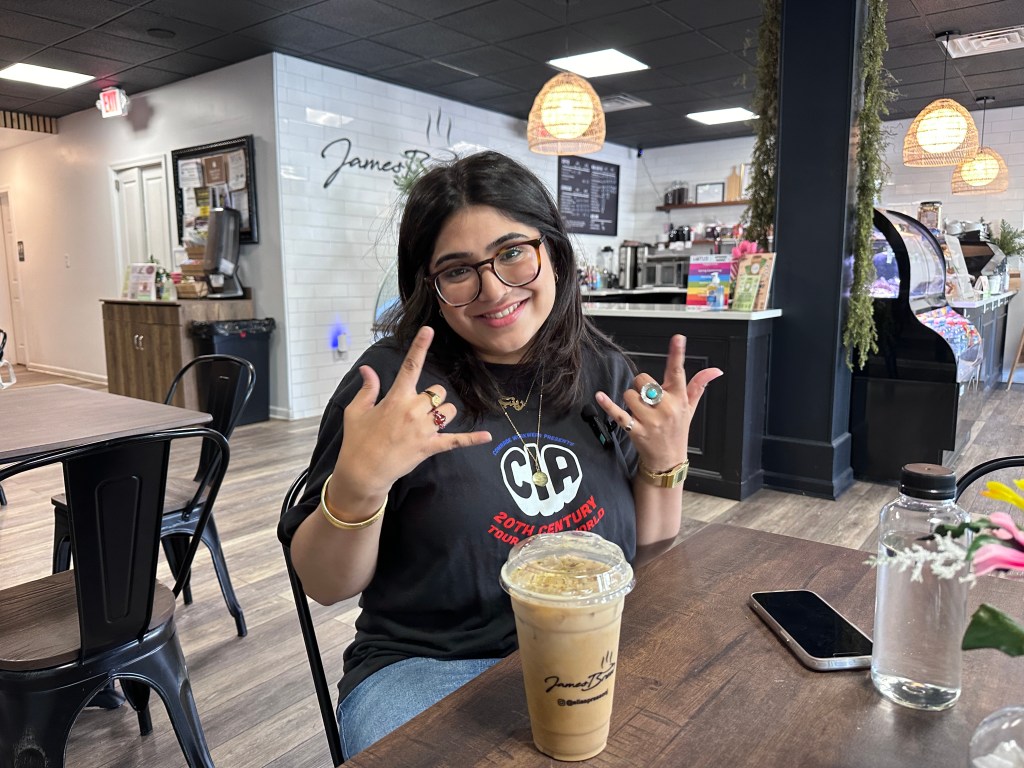
coffee date #55 with zainab khan
high school world history teacher, jewelry queen, Pakistani Punjabi, Rutgers alum, a-stranger-who-became-a-friend, world traveler, wisdom seeker, photography legend
me: honey lavender latte | zainab: pistachio latte
location: jamesbrew café, new jersey
Meeting Zainab feels like a little trick manifested by the Universe.
I met Zainab on a chilly, summer night in Princeton a few months ago. My friend and I were stuffing our faces with Tacoria while sitting on a bench.
At this point, my friend made a comment relating to a random conversation we were having and I replied with a sarcastic “Oh great, I’m just gonna kms.”
The girl at her car, which was conveniently parked right next to our bench, turned around and sweetly yet equally sarcastically said, “Oh no, now don’t do that.” That girl was Zainab.
The three of us then chatted for nearly thirty minutes. We went from introducing ourselves to learning about each other’s professions to screeching over some of our mutuals. After exchanging Instagram ID’s and taking a cute little selfie to commemorate this adorable moment of bonding with a stranger, Zainab drove away. I thought that would be the first and last time I’d ever see her.
Here we are now: no longer complete strangers, talking to each other about the most intimate, delicate situations to the most lighthearted, fun events in our lives.
Diving into the world of Zainab Khan …..
Epiphanies
- the power of history
History has always consistently been my worst subject in school. I never enjoyed history classes and found them to be extremely dense, repetitive, and mundane. For the first time, Zainab dissected why history classes may not have gone so well for me and that was a crazy revelation.
Zainab stated that oftentimes history in schools is taught in a way that separates students, making them feel as though they are “visitors” of the historical concepts. In other words, those students often feel as though they don’t belong in the space, which can eventually lead to a lack of interest, curiosity, and passion for the subject.
“In order to understand what the purpose of history is and truly feel interested by it, you have to see yourself in it.” – Zainab Khan, 2024
During our conversation, I also realized the powerful lasting effects of history because it’s not a subject that you just leave in the classroom. The skills that we can gain from understanding and learning history have the ability to stay with us forever.
Zainab explained that there are 4 main skills that come with learning and enjoying history:
- ASK QUESTIONS – What’s missing from this perspective?
- CONTEXTUALIZE – Being able to put everything into context before coming up with an analysis
- DELIVER INFORMATION – Being able to dissect and share information
- CREATIVITY – Putting all these skills together to come up with your own perspective
With the current injustices happening around the world, when Zainab explained these skills to me, I realized that the skills gained from learning history are almost immediately applicable to our day-to-day lives.
- how can we understand the history of Israel and Palestine?
I would do this section more justice by adding the audio version of the conversation below.
“Land = Power. We fight over land, and we forget that people live on that land.” – Zainab Khan, 2024
- patriotism & nationalism: India vs Pakistan
I am all for loving and rooting for your country, but just like with anything in life, an extreme love, pride, and gratitude for one’s country can cause a shit ton of damage.
Let’s look at India and Pakistan, for example.
When it comes to movies, India and Pakistan are displayed as “enemies” in quite literally every nationalist Indian film I have ever watched (and I’m sure such movies exist in Pakistan as well). The most recent example being Yodha and Fighter. Both films included an Indian hero fighting a Pakistani “terrorist.” As an audience member, I’m tired of watching the same trope in every one of these patriotic films. Why is it always India vs Pakistan even in fictional settings like movies? As we know, this prejudice shows up in fictional movies because it’s a prejudice that still exists in the real world.
Similar to movies propelling the hate, India vs Pakistan cricket matches also have similar effects. When India and Pakistan play each other, people who never ever watch cricket suddenly pop out on the streets to intently watch these two countries “battle it out” on the field. Zainab explained that there was even a time when her entire school closed to allow for the kids and their families to watch the India vs Pakistan match.
When I asked Zainab to provide me with her reflections, she essentially answered with two words: Colonialism and Nationalism.
“A lot of people, groups, communities, and ethnic groups were torn apart due to colonialism. A whole country (e.g., Bangladesh) that had its own ethnicity, characteristics, and culture was torn apart after the creation of India and Pakistan. These are just lasting effects of feeling like we have this competition – feeling like we have to win in the eyes of British imperialism and colonialism.” – Zainab Khan, 2024
Mind = Blown.
- overcoming and preventing activism burnout
Firstly, I’ve come to not like the idea of labeling myself and others as an ‘activist’ because I realized that we’re all activists in our lives, in some way or the other.
Some of us advocate for large-scale social injustices, such as the crises occurring in Palestine, Sudan, India, and many other places worldwide. Some are advocating for their right to take up space and feel like they belong. Some are advocating for the safety and wellbeing of their children. Others are advocating for themselves by leaving harmful relationships.
Every time we act on a decision that serves either ourselves or others, we are advocating for something, and that makes us all activists.
When we get involved with activism without setting boundaries for ourselves, there comes a point where we may experience something called burnout. Burnout can feel like an overwhelming feeling of exhaustion, hopelessness, and maybe even numbness to the cause.
“You have to remind yourself that you’re fighting for something that is bigger than you and it might even be bigger than the next generation. It’s a lofty goal. The minute you start feeling hopeless, that’s when you need to take a step back and find somebody.” – Zainab Khan, 2024
When I asked Zainab how we can avoid feeling this overwhelm so that we can then prevent burnout, she gave me a rather refreshing answer.
Zainab explained that a large part of activism is shared joy. She further elaborated that the whole point of activism is to feel united with our communities; to feel a sense of liberation; to feel love and be loved; to feel joy. She also emphasized that this is different from toxic positivity. Toxic positivity is formed by negating the truth, while shared joy is based on focusing on the outcome or the result of the activism.
“Joy is a form of resistance.” – Zainab Khan, 2024
Thank you Zainab. Thank you for reminding me to sometimes shift my focus from the what? to the why? Thank you for sharing that part of the burden of activism is feeling it; for teaching me that maintaining joy is also a form of activism; for helping me understand how to continue the fight for a long period of time until eventually every marginalized and oppressed group of people can experience liberation and the joy that comes with it. Thank you ❤️
 Esha Kode