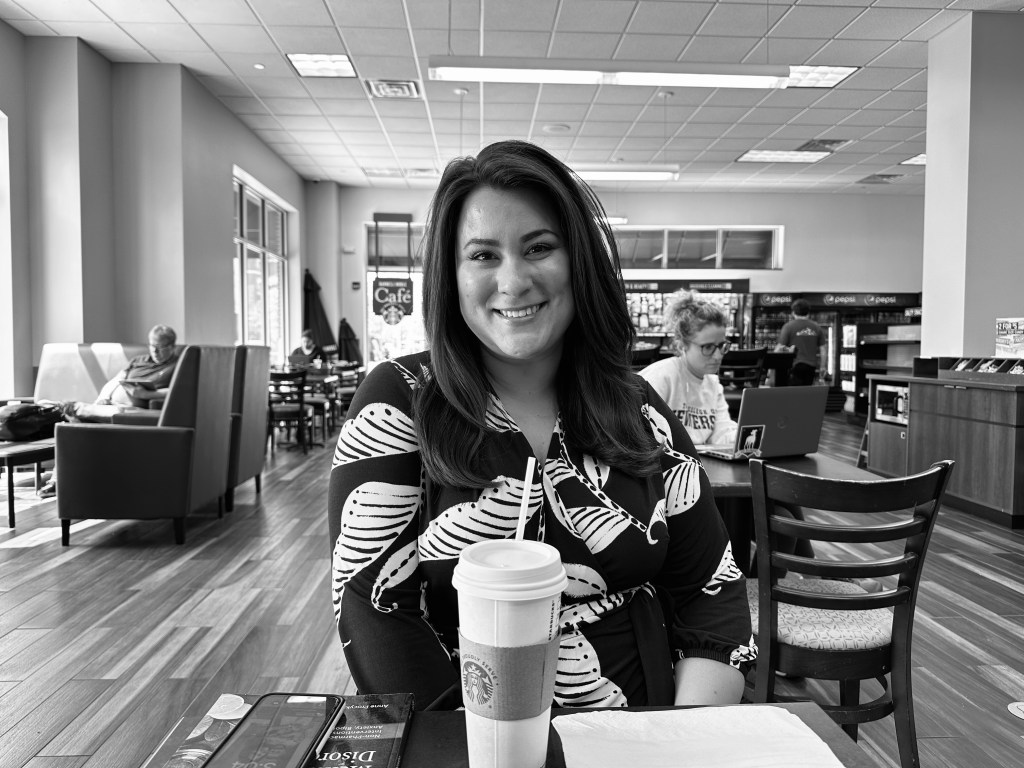
coffee date #49 with michelle lambing
Assistant Director for Anti-Violence Initiatives at TCNJ, feminist, licensed professional counselor, TCNJ alum 🥺
me: iced hazelnut macchiato w/ oat milk | michelle: caramel macchiato w/ skim milk
location: starbucks, new jersey
After two years of hearing my upperclassmen friends talk about how amazing Michelle Lambing’s “Psychology of Women” class is at TCNJ, I finally managed to get into the class last semester.
Day 1 of class, Michelle said “Call me Michelle.”
I, along with others, squirmed a little bit at the thought of calling a professor by their first name.
Michelle explained that using credentials and associated honorifics play into the power dynamic in society. Knowing that the purpose of the Psych of Women class is to educate students about feminism, toxic masculinity, and also encourage us to deeply reflect on how we’ve been conditioned to believe in those ideas as well, Michelle wanted her students to feel safe amongst each other and also around her.
Thus, every email and conversation I’ve had with her since I’ve referred to her as “Michelle.” She was right. It did make me more comfortable to share some stories in our weekly response papers, send an email, and even speak up more in class. Michelle created a sense of equality.
Michelle’s superpower, based on what I’ve observed during class, is her ability to be so empathetically vulnerable, which creates an incredible space for other people and their stories. Granted, this is why she is such a stellar counselor at the college.
My first coffee date with a past professor – wild.
Diving into the world of Michelle Lambing….
Epiphanies
- career planning – not an ‘all-or-nothing’ approach
“We’re expecting too much of people. Life is a journey and a process. It’s not just a series of checkboxes.” – Michelle Lambing, 2023
I was taught to think of careers as an ‘all-or-nothing’ concept, where my first job has to be the end goal. There isn’t room, time, or a need to ‘dilly-dally’ with other jobs when you could be focusing on that ‘actual’ job/career you want.
That mentality quickly changed come sophomore year of college. At this time, I decided that I would most likely need to take a gap year (or two) before beginning medical school. I was burnt out and also wanted to follow through on some creative pursuits before med school takes over. It took me close to a year to convince my parents to be okay with me taking a gap year.
When Michelle explained that careers are not meant to have a linear trajectory, but in fact, should be thought of one step at a time, it felt incredibly validating.
“Your next job does not have to be your perfect dream job. Your next job has to serve your needs. You do what’s the next right step and not necessarily what’s the end goal.” – Michelle Lambing, 2023
She further noted that your ‘next step’ should be based on what you need in that given moment. If you need freedom from your current living situation or need work benefits, maybe it’s better to enter the workforce so you can leave the house and get the associated benefits. If you’re still hungry to learn more, then maybe a job is not what you need right now and grad school is a better option.
What I need after undergrad is a break so I can write more, spend more time with the boys at Bal Ashram, and kickstart new project ideas I had in mind. Thus, the ‘next right thing’ for me, is taking a gap year and entering medical school when I am actually ready to.
Thank you Michelle 🙂
- who am I?
Identity is a weird thing. Before chatting with coffee date #23, I believed that our identities should be wrapped in our professions. After all, we work so hard throughout our lives, jumping from one job to another, from one career path to another, it only seemed fair to identify oneself with one’s profession. Coffee date #23 disagreed.
“We are so conditioned into wrapping our identity to what we do.” – Michelle Lambing, 2023
Almost 2 years ago, after my conversation with coffee date #23, I wrote:
“We are so much more than our careers. Our life cannot be determined solely by the profession or career path we choose. That’s an insane amount of pressure to place on a single aspect of our life when our life is actually composed of numerous aspects.”
Two years later, I am still on the same thought – if we’re not our professions, then what are we?
Michelle and I discussed how when we want to move past identifying ourselves with our professions, we default to our other roles in society (i.e. being a mother, daughter, etc.). Upon reflecting on these roles, we realized that, as women, these roles are all associated with us being in connection with other people. So now what?
Then we default to our hobbies. I’m a runner/writer/painter.
But what do our hobbies mean? What do they tell us about our ‘identities’?
During the date, I also mentioned that when I identify myself with my hobbies (such as writing), it doesn’t “feel like it’s enough” because I feel like I am more than just my hobbies.
Michelle replied to my “but that doesn’t feel enough for me” statement by saying:
“That is probably a product of our conditioning. Whatever it is outside of our career, how could that possibly measure up? And that’s just part of our conditioning of always trying to prove ourselves.” – Michelle Lambing, 2023
Damn. This, once again, brings us back to the original question:
Who am I and what is a part of my identity?
A loaded question that may not have a perfect answer: to be continued…
- forgive & forget
Whenever I communicate to my mom that something she did/said a while ago hurt me, she’ll apologize and quickly say “okay now can we forget and move on?” If I bring it up again, she’ll be quick to respond with “why can’t you just move on? It’s not good to hold grudges.” This obviously leads to more grudges and does not help me ‘forget’ or ‘move on.’
Thus, I’ve been ruminating about this concept of ‘forgiving & forgetting’ for a while now. Why must we forgive and forget an incident or time in our lives that caused us a lot of hurt and pain?
Let’s talk forgiveness first.
Michelle started by describing how in her early 20s she was still working through some trauma as a survivor of domestic violence, and continued to have a lot of anger towards her Dad. She noted that she eventually got to a place, where one day she was driving and thought of her Dad. She hadn’t seen her Dad in years, yet as she was driving she suddenly thought “Well, wherever he is I hope he’s doing well.” Michelle explained that she was struck by this thought because it showed her that she had finally gotten to a place where she had forgiven him. She stated that by reaching this place of forgiveness, it was not about condoning her Dad’s behavior, but more-so about finally reaching a point where she was able to release her anger.
The important thing to note here, though, is the fact that forgiveness is your choice and is still you holding onto the power. Forgiveness often feels like you’re giving up or giving back that power to the person that caused you harm. This may be because you were almost guilted into forgiving that friend in your friend group or that parent in your family to maintain peace and harmony because the rest of the folks in that group felt uncomfortable in the discomfort. Thus, Michelle explained that productive conflict is necessary, especially if we want to reach a place where we can forgive with our whole hearts, on our own terms.
“When I go through the resolution process, I have to work with the victim or survivor around forgiveness and closure. A lot of times, they go into the process hinging their closure/forgiveness on how good of an apology they are going to get. We have to disconnect their closure and forgiveness from the respondent’s performance because we cannot predict that.” – Michelle Lambing, 2023
Michelle also noted that waiting for a certain type of apology for the respondent is ineffective because it, again, feels like you’re putting power back in their hands when “you can take that [power] back and define it for yourself within your own control.”
Now, onto the ‘forgetting’ part.
Is it logical to forget the way someone treated you?
Michelle and I both agreed that it is not entirely logical to forget. She explained:
“Our brains are like Velcro for negative experiences and Teflon for positive experiences. This is a survival instinct, where our brain takes in all this information and internalizes the negative experiences so that we don’t get hurt again.” – Michelle Lambing, 2023
Holy crap. Remembering how someone treated us is literally a physiological process that prevents us from getting hurt again, so why would we not want to remember?
“If someone has hurt you that deeply or that often that you were like this is no longer a good relationship for me to be in, I think that’s accountability and boundary setting.” – Michelle Lambing, 2023
If, on the other hand, the person understands you and respects your boundary once you were able to use your ‘I statements,’ then that relationship may be worth being invested in. However, if the actions are repeated and your boundaries are continuing to be violated, then there’s no need to ‘forget and move on.’ Instead, maybe it’s time to re-evaluate and potentially even exit that relationship.
All in all, forgiveness is your decision to make and yours alone. It should not be tethered to how the other person will react and surely does not mean that you are giving up your control. It’s up to you to decide when you are ready to forgive and release the emotions associated with that person and the experiences you had with them.
Forgetting, on the other hand, is simply not logical. Use your ‘I statements’ and set your boundaries. If your boundaries are respected, great! – you’re moving through conflict in a healthy way. If your boundaries are violated, re-evaluate that relationship.
- EMOTIONS ARE DATA
One phrase I’ve heard Michelle repeatedly say during class is “emotions are data.” She used to emphasize the importance of listening to our emotions.
“Emotions tell us what the next right thing to do is for ourselves.” – Michelle Lambing, 2023
In our productivity-oriented culture, we tend to neglect our emotions and let external entities control us. We push through even when we’re exhausted. We suppress anger because we’re afraid to be uncomfortable with confrontation. We binge & purge because we feel out of control.
Therefore, according to Michelle, the first step is to recognize that we have emotions and they are there for a reason.
The second step, then, is to tune into those emotions to allow them to guide us.
For example, when we feel resentment towards someone, Michelle explained that that may be a result of a boundary being crossed.
“An emotion is always an invitation to reflect.” – Michelle Lambing, 2023
Furthermore, Michelle unpacked anger and mentioned that anger is usually a secondary emotion. When we unpack anger, we find that pain is often underneath.
Anger is usually associated with ‘bad behavior’ and we tend to create a lot of shame around this emotion. What we are actually doing is not creating space for people’s pain.
While writing this post, I found the podcast that I listened to a little over a year ago^^^. 10/10 recommend!
- the power of media literacy
During the Psych of Women class that Michelle taught, she continuously emphasized the importance of media literacy. Thus, I asked her to explain why she believes media literacy is so important.
“I want you to be able to look at a post and be able to choose whether or not to internalize it as opposed to readily internalize it. If you don’t have that insight or awareness, you might readily believe messages about yourself that are untrue and create shame, which acts as a catalyst for depression, anxiety, and eating disorders. I view this as a form of a prevention.” – Michelle Lambing, 2023
Looking back, I realize that I readily internalized so many things about how a woman should be and look through the Disney channel shows and Netflix hits like Vampire Diaries and One Tree Hill. If media literacy was introduced to me at a younger age, like in elementary school, maybe I would’ve been more equipped while viewing such media.
Furthermore, Michelle also mentioned that she even practices media literacy with her 9-year-old daughter. While watching a show, Michelle will whisper in her daughter’s ear about how what she’s viewing or hearing may not necessarily be true. When she’s playing with a Barbie doll, Michelle will point to the Barbie’s waist and note that the doll’s waist isn’t real so that her daughter does not internalize these implicit body standard messages.
Media literacy is powerful and should be a necessity for children and adolescents today, especially, because social media has become such a prevalent part of today’s world.
 Esha Kode