dear diary

I am currently living at the Bal Ashram in Jaipur, Rajasthan. I am a 100 Million U.S. Campaign intern and the foundation that that campaign is a part of runs this Ashram, which is a long-term rehabilitation center for boys rescued from child labor & trafficking. I’ve been living here for a week, teaching children about emotional well-being and doing one-on-one sessions with other boys who have learning disabilities. I only have one more week to go 😦

I realized that I’ve become rather possessive of these boys. I just want to squeeze all of them into my pocket and take them away with me. At the same time, I feel like I haven’t been doing enough for them. I don’t know any of the legal matters or policies regarding child labor. I am not a licensed therapist. I am also not a certified teacher. I don’t know who I am and what I can offer these children other than just my presence. And I don’t know if my presence is enough.

I want to be able to fix their lives and take them back to a stable household. I want to be able to fight for their rights in court. I want to help them psychologically. I feel like I am running out of time, but I know that’s false. However, it’s hard to continuously fight against your own thoughts.

One of the volunteers I met here, Julia (aka my next coffee date), told me that when working with children like these, we just have to keep reminding ourselves that we are enough, we are doing enough, and our work does have meaning.

I want to take it easy in 2023 and not put a timeline on my passions; I want to let my passions guide me, instead of the societal construct of a certain timeline. I don’t want to compare my passions and work with other people who may have similar interests. Everyone works at their own pace and in their own way. I want 2023 to be the year where I pursue my passions and relentlessly stand up for myself and the causes that I support.

Welcome 2023.

‘b****’: let’s unpack it.

Those of you who have been here a while know that I am a podcast fanatic. I have recently been hooked to Meghan Markle’s Archetypes, which dissects and explores the tropes and labels that have been or are still used to hold women back.

In her recent episode, Meghan sat down with Andy Cohen, Executive Producer of the Real Housewives franchise. Andy mentioned in the episode that one woman in the Real Housewives franchise wanted to use the b-word in her tagline. The word was not approved, however, Andy mentioned that the woman did make her case for why she does not feel offended by the use of that word. On the other hand, Meghan analyzed the b-word and how it was used to belittle women in the past during one of her previous episodes. She was shocked to hear that people from the current generation don’t mind the b-word because it’s used so often. Some also claimed that the b-word is easier to bear compared to all the other words/labels being thrown around today.

I was first introduced to the b-word in elementary school. In fact, I was considered to be one of the “late users” of the word. I didn’t begin using it until around eighth grade because at that point I had heard all of my fellow classmates use it so regularly, so obviously my 14-year-old self adapted to her social environment.

Here’s a confession: Today, I tend to use this word more often and with many of my friends. The b-word is a common vocabulary term that we use to sometimes greet each other, express anger, describe something, etc. However, I don’t think many of us realize that there is such a deep-rooted sexist history to the word. Thus, hearing Meghan Markle describe the b-word as a demeaning label for women was a shock to me, prompting me to research all about it.

what does it mean.

A “bitch” supposedly means a female dog. I’m not sure if this was common knowledge or not, but I simply had no idea or I was just oblivious to the fact that there is an actual definition of this word in the dictionary.

a quick history lesson.

The use of the b-word originates back to the 1400s (Hodgson, 2008). Apparently, calling a woman a b**** was used to accuse her of “being worse than a prostitute because at least a prostitute stood to gain financially from the broad distribution of her sexual favors” (Hodgson, 2008). Let’s pause really quick. Coffee date #5 is a strong advocate for substituting the word ‘prostitute’ with ‘sex workers’ or ‘sex professionals’ because it accepts/validates their labor. Therefore, it is crucial to note that the b-word is seen as something worse than, yet another, sexist, belittling label.

There’s also a link to the b-word and the Greek Gods. Supposedly, the Greek goddess Artemis-Diana, who was the goddess of the hunt, was often depicted as being in the presence of dogs. To spread Christianity and suppress the idea of a female being idolized, Christian Europe used the phrase ‘son of a bitch’ to criticize those who believed in Artemis-Diana (Kleinman et al., 2009). Therefore, this showed that the term ‘bitch’ was used to eradicate images of powerful and capable women by “equating them with sexually depraved beasts” (Kleinman et al., 2009).

why it is used.

Kleinman et al. states that “feminists analyzed that preference [the need to use ‘bitch’ over any male-associated terms, such as ‘jerk’ or ‘dickhead’] as internalized oppression, whereby members of an oppressed group learn to enjoy using the dominant group’s term for them” (2009). *jaw dropped. eyes bulged. gasped for a hot second.*

how it is used.

As mentioned previously, my friends and I tend to use this word nonchalantly. Some of us even use it to describe objects or events. For instance, let’s say we take an incredibly hard exam. Many might say that that “exam was a real bitch.” Others who still struggled through the exam, but felt that they did well might say “I bent that test over and made it my bitch” (these example quotes were taken from the Kleinman et al. paper).

In the former example, the b-word is being associated with “difficult” – yet another label often used to belittle women. In the latter example, the b-word is being associated with something that can be controlled, dominated, or conquered (Kleinman et al., 2009). And for how long have women been controlled and dominated in our largely patriarchal world?

Therefore, the paper noted that using the b-word over any other terms associated with men or masculinity (for example, people rarely say ‘that exam was a real jerk‘) to describe objects is further indicates just how abusive the b-word is towards women and how its use is fueling sexism.

The b-word is also often used in the political space, especially during heated debates and in media articles. During the 2008 primaries in the United States, Sarah Palin was supposedly “viewed as emasculating John McCain, who was then labeled a “bitch” in a comedic YouTube clip titled, “Is McCain Palin’s Bitch?”” (LisaNova, 2008). The fact the b-word was being used to describe a man, a white man nonetheless, immediately displays that its purpose was to ’emasculate’ him. It was also intended to insult the man for allowing himself to be dominated by a woman *insert dramatic eye roll* (Kleinman et al., 2009).

the conclusion.

Honestly, Kleinman et al.’s paper Reclaiming Critical Analysis: The Social Harms of “Bitch” has been incredibly insightful and eye-opening (2009). It shed light on exactly why the b-word is so offensive and why Meghan Markle was so confused as to why this term is such a normal part of millennial vocabulary.

Words hold so much power. They can be healing, grounding, and therapeutic. Yet they can also be sexist, demeaning, and continue to fuel all the labels and stereotypes attributed to different genders, races, classes, and people in general. Thus, we must choose our words carefully and accept it when we are oblivious to terms that are harmful and degrading. From acceptance, we must move towards change and that change can stem from something as simple as conscientiously removing such terms from our vocabulary.

Here are some other related articles and resources I found for any of you interested folks:

  1. Use of the word “bitch” surged after women’s suffrage (Zhou, 2020)
  2. What’s so bad about being called a ‘bitch’? (Taylor-Coleman, 2016)
  3. The Harmless-Sounding Phrase That Is Terrible for All Women (Rinaldi, 2017)

podiatry. what is it?

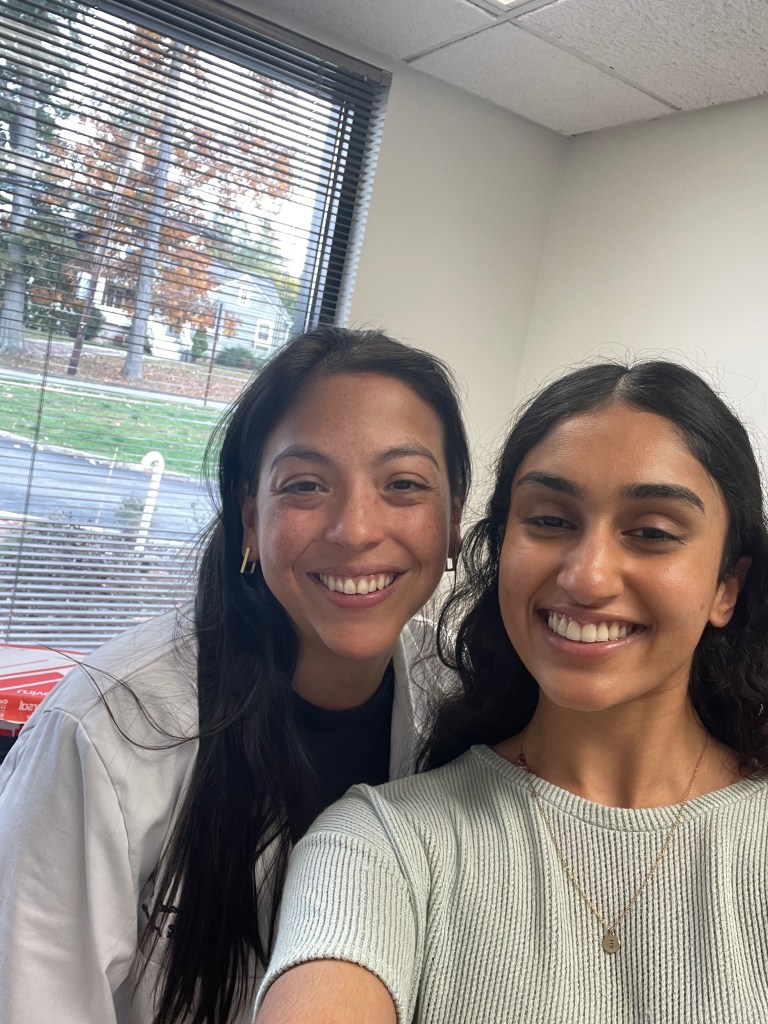
a quick end of shift selfie with Dr. Heidi Godoy!

I was first introduced to the field of podiatry through Dr. Heidi Godoy’s presentation to our AMSA club a couple weeks ago. One of the things she said that stood out to me was: “a lot of people do not understand the importance of our feet – they help us walk and move.” Thus, I emailed Dr. Godoy and asked if I could spend a day shadowing her in her office, to which she immediately agreed! Fun fact: Dr. Godoy is a TCNJ alum!

Dr. Heidi Godoy, DPM, practices at the Alps Family Foot & Ankle, which is a family (and women) run practice composed of Dr. Heidi Godoy and Dr. Johanna Godoy (and previously their mother, Dr Irma Godoy) – girl bosses!

When I first entered the office, Dr. Godoy handed me a white coat (rather casually) and I remember hesitating to take it from her for a quick second because that’s the coat that so many pre-meds hope to wear one day. To be able to wear a white coat, enter a patient’s room, and just be on the other side of medicine was such an insanely wholesome feeling.

Dr. Godoy is simply amazing! Her energy is just so positive and inspiring. Our conversations were fun, educational, and easy. She taught me to not put so much pressure on myself. Everything will work out. Relax.

She also truly is such a boss. Along with handling the clinical side of medicine, she also (rather effortlessly) handled the administrative duties. She was answering patient phone calls, retrieving materials from the storage unit, scribing her charts, responding to emails, and so much more. What a queen.

This shadowing experience taught me more than I thought it would, hence why I wanted to wrap it all up into one blog post so I have a place to refer to this experience.

There are a diverse group of patients that come to a podiatrist. In the 5 hours that I spent at the office, I saw Dr. Godoy interact with patients with all sorts of different conditions that affect the entire lower legs. I’ll recall some patient interactions below and reflect briefly on what their complaint, diagnosis, and treatment plan was (note: the patients are named with letters of the alphabet to abide by HIPAA rules).

  • Patient “A”

Our first patient was an elderly person, who presented with Athlete’s foot and some left foot toenail discoloration. This patient came in with the intention of just getting their toenails trimmed. However, once Dr. Godoy saw the patient’s feet, she recognized that Patient “A” had Athlete’s foot. Luckily, Athlete’s Foot is not a serious condition and is very much treatable. The patient was instructed to apply an anti-fungal cream and ensure that they were wearing shoes that weren’t so tight-fitting.

Afterwards, Dr. Godoy explained to me that some of the older patients come in to get their toenails cut because they are physically unable to do so themselves. This also enables the doctors to examine their feet to ensure that there isn’t any sort of infection or problem with the feet. Watching Dr. Godoy interact with people like Patient “A” was very humbling because it showed me that medicine is not always about the ‘life-changing, cancer-curing’ treatments. Medicine is also about making the ‘everyday’ things more accessible to every single person.

  • Patient “B”

Patient “B” was another adorable older person, who appeared to have mildly painful pressure calluses at the bottom of her foot. It was during this patient interaction that Dr. Godoy taught me about the two pulses that are present in the lower legs. One is called the dorsalis pedis (DP) pulse, which is palpable at the top (or dorsum) aspect of the foot. The posterior tibial pulse is palpable at the intersection between the ankles and heels. Dr. Godoy explained that the latter type of pulse diminishes over time with age due to a lower amount of blood reaching that area (Patient “B” had strong DP pulses, so there appeared to be no concern).

  • Patient “C”

This patient was the first pediatric patient I saw at the office (Dr. Heidi Godoy is also specialized in pediatric podiatry)! Patient “C” came in as a ‘post-op’ and received an XR at the office. This was cool to watch because as a scribe, I only go into patient rooms with the physicians during the initial consultation. I don’t get to see the patients follow through on the orders placed by the physicians. Therefore, being able to see this patient receive an X-Ray was intriguing as I was able to piece together everything from my scribe job. It was also interesting to see the patient get scanned in the office and have the results pop up immediately on the screen. Dr. Godoy pointed out that the area that looks mildly indented is where the patient sustained a trauma injury and fractured that area.

I also learned that toenail fungus is a rather common result of trauma. This patient suffered from a foot injury and as a result came to the office with an obvious fungal infection around the area of trauma.

  • Patient “D”

Patient “D” presented with a fungal toenail infection – their entire big toe was discolored. The patient explained that they get a pedicure regularly and has never seen something like this before. Dr. Godoy explained that nail salons are the main places where people can acquire such fungal infections (wild!).

Nail salons do not sterilize their materials enough (they usually just drop them in some alcohol). Since fungus loves to travel in areas that are moist, dark, and metal, nail salons provide the perfect environment for fungus to grow. Thus, when one gets a gel manicure, the fungus loves to thrive in the darkness under the gel on our toes. *irky*

The cool part about this patient interaction was that I watched Dr. Godoy literally cut off the entire fungal toenail! Not gonna lie, that was a bit difficult to watch because nails, in general, just freak me out. However, the process of actually removing an entire toenail to treat this condition was awesome!

Dr. Godoy then proceeded to explain to the patient that there are usually two forms of treatment for fungal infections: (1) an oral pill or (2) a topical ointment. The patient ended up choosing the topical ointment. Dr. Godoy further explained the process of applying that ointment: it must be applied from the nail bed and cover the entire nail in order to ensure that any residual fungus is being killed.

  • Patient “E”

Patient “E” also presented with a toenail infection. The difference between “E”‘s fungal infection versus “D”‘s was that Patient “E”‘s toenail was not discolored – the nail was just growing thicker. I had no idea that thicker growing toenails could also be a sign of a fungal infection!

Dr. Godoy explained that the treatment for this infection would involve softening the nail first to allow for the antifungal ointment to be able to reach the fungal infection.

Before prescribing the ointment, Dr. Godoy checked the patient’s insurance company. Based on the insurance company, Dr. Godoy offered the patient a different antifungal ointment, which has essentially the same effects as the usually prescribed one. The only reason why Formula 7 (i.e. the antifungal offered to those who do not have insurance that covers Jublia) was the better option for this patient was because it is a lot less cheaper. This showed me that it is crucial that doctors are not single-minded. If multiple patients present with the same symptoms, treatments must be tailored to not only their own somatic needs, but also financial needs.

  • Patient “F”

Patient “F” presented with an ingrown toenail. Dr. Godoy had to perform a partial nail avulsion to treat this patient’s ingrown toenail. She needed to anesthetize the area, for which she mixed a short-acting anesthetic (i.e. lidocaine) and a long-acting anesthetic in the injection. She then proceeded to use a cold spray before injecting the patient’s toe with the anesthetics. Cold sprays are used before the injection to “provide transient anesthesia via evaporation-induced skin cooling, which reduces pain. Results from studies of earlier vapocoolant sprays indicated that they reduced pain due to vaccine injection in children and adults.” Dr. Godoy then injected the patient with the anesthetics. She took a sterilized metal tool and was able to maneuver inside the toe and very elegantly scooped the entire ingrown toenail out. EPIC!

  • Patient “G”

Patient “G,” who has a history of uncontrolled diabetes, presented with a ‘pins and needles’ feeling in their foot. This patient was the perfect example of someone who had fallen through the cracks of the American medical system. They explained how after selling their business, they could no longer afford insurance. Thus, for almost a decade, their health practically deteriorated due to their unfortunate financial constraint.

Upon Dr. Godoy’s examination, it was seen that the patient’s condition is more so a neurological problem than a podiatry related condition. Along with diabetes, the patient explained to Dr. Godoy that they also have history of chronic back pain. Dr. Godoy replied that back pain can also be related to foot pain.

This patient interaction taught me two main things:

(1) Everything in the body is connected to everything in the body. Pain in one area can result in pain in the other area.

(2) Health is often put on the backburner for those who cannot afford to consult a doctor until their conditions become unbearable. How can this situation be better handled so that people are not afraid to go to a doctor during the early stages of their pain/conditions?

  • Patient “H”

Patient “H” presented with heel pain. With a quick examination, Dr. Godoy was able to diagnose the patient with plantar fasciitis. Plantar fasciitis “occurs when the plantar fascia, a strong band of tissue that supports the arch of your foot, becomes irritated and inflamed.” A common sign of this condition (along with heel pain) is having a tight calf.

There were 2 parts to the treatment plan:

  1. Dr. Godoy administered an injection consisting of a corticosteroid (e.g. an anti-inflammatory), short-acting anesthetic (e.g. lidocaine), and a long-acting anesthetic.
  2. The patient was then provided a “Night” splint to help stretch out the calf and release the pressure placed on the heel.

Conclusion

I am ecstatic that I was able to connect with Dr. Godoy and learn some details about podiatry. More than the actual diagnosis and medical part of the learning process, this experience taught me that I have to be open-minded when entering the field of medicine. It sounds so trivial, but I don’t think this is emphasized enough for pre-med students. A lot of us who want to enter the medical field already have this pre-set idea of what medicine ‘looks’ like. However, we do not realize that medicine is so much greater than what we know – it encompasses fields and people from all sorts of different backgrounds.

Note to self: Be open to learning and exploring. Thankful I got to do just that with Dr. Godoy 🙂
when you feel like the world is ending…

inspired by Lana Blakely’s video.

writing this post to remind myself of all the things that keep me sane – it’s a never-ending list and something that I can always refer to on the days I feel gloomy 🙂

when you feel like the world is ending, think of these:

the soggy, muddy grass against your feet after the sprinklers have just turned off.

the smell of your morning cup of coffee as the warmth of it spreads across your face.

the sinking feeling of your heart when you’re at the top of the swing on the playground.

the way your brother smothers you with his entire body when you just want to lay down and Netflix.

the way your cousin sits and listens to every one of your words when you need someone the most.

the view of the sky connecting with the height of the trees during your long car rides.

the smell of your brother’s fart in the car prompting you to roll all the windows down and let the smell of nature fill the air.

the way you wake up to the annoying, yet soothing chirps of the birds.

the sound of shawn mendes or b praak making you want to release all that you have bottled up for weeks.

the feeling of the spring wind against your skin causing your little hairs to shoot up.

the redness and pulsing of your heart after a challenging and invigorating workout.

the tears and wholeheartedness you feel after watching dear zindagi for the millionth time.

the random hugs, slaps, and spicy fries sponsored by shivdaballer.

the kind souls you’ve met because of the fifty coffees.

the bubble tea in princeton.

the love the family in houston showered you with.

the dream of saving so many lives once you become a surgeon.

the sound of glennon doyle in your ear telling you to just sit still and find your ‘knowing.’

the fierce eyes of a lion on top of a mountain.

the smelly armpits of your brother and ravali that suffocate you during a movie night in the basement.

the idea that life is very vast, but you live day by day.

the average life span is around 80 years and you’re only 20. only 20.

the fact that you have a blog and you pour your heart out in these posts and coffee dates.

the taste of nani’s warm rasam rice mixed with spicy chicken curry.

the understanding that you are enough and everything happens for a good reason.

the sound of the waves of the ocean aligning with the beat of your heart.

Physical Touch

I was known for being the “Touch Me Not” child while growing up. When all our relatives used to visit, they’d squeeze my cheeks, bring me in for a hug, and hold my hand while speaking. I remember never really liking that physical touch. I was never a hugger nor a fan of physical touch. Many of my coffee dates can attest to that.

This past weekend, however, I somehow enjoyed the hugs, kisses, and the touch.

This weekend, I met new faces and rekindled relationships with so many of my family members. This environment was unlike any other family environment I’ve been in. These people were just exuding so much love and had no other ulterior motives other than to just shower me with as much kindness as possible.

Many of these people were grandparents and aunts & uncles I met when I was just a kid. They held my hand affectionately in their hands as they spoke about their lives – some would even go on to speak about their own marriages, life trajectory, and their kids. My heart was jumping in joy as I reconnected with so many of these wonderful souls and learning that love can be a very beautiful feeling.

Now, as I am reflecting, I realize that the reason why I was never a fan of touch was because my parents never showed their love through physical touch. I wasn’t used to it and I didn’t understand it, which is why when others prefer this love language, I oftentimes have no idea how to react.

I will now no longer avoid those intimate moments with people I love because I realize that I enjoy this kind of love – the love that doesn’t need to be shown through words or money or large actions. It makes my heart giggle and makes me wanna say ‘ily‘ to the people in my life who make my world so happy.

Outliers by Malcolm Gladwell

Quick Synopsis: Gladwell takes a look at a person’s background, culture, ancestors, etc. all to explain how they became who they are. For example, Bill Gates is who we know as a successful and wealthy entrepreneur, making him an outlier. However, his success is not attributed to him alone. It’s due to his family, the school he went to, the hours he spent with computers. It’s even due to the year he was born in.

I had so many moments of utter shock while reading this book. Here are some of the things that I learned:

  • It takes 10,000 hours to reach the level of mastery.

Bill Gates reached his level of mastery with computers because he supposedly used his wealthy school’s computers all the freaking time, starting from a young age. Therefore, by the time he developed Microsoft he had already covered or was near to covering 10,000 hours of work.

If we all put in 10,000 hours solely for our passions and into our desired professions, we too would be on the Forbes List.

  • Privilege and power play a large role in your success.

Gladwell talks about Chris Langan, the smartest man in the world. Chris Langan did not have much power or privilege, causing his intelligence and “success” to go largely unnoticed. Gladwell talks about the moment when Chris’s high school teachers didn’t engage him with more challenging work as he was always 100 steps ahead of all of his peers due to his high IQ. Thus, he spent most of his high school time self-studying and eventually earning a perfect score on the SAT.

Langan proceeded to receive scholarships from 2 colleges. He attended one of them and was subsequently kicked out because his mother did not send in his financial information in time. Gladwell even mentions that Langan was denied his request to attend class at a later time because he had a broken down car.

Chris Langan’s opportunities were bare and few, and even when he wanted to act upon them, he couldn’t because of his social background.

There are A LOT of interesting stuff in this chapter that I can’t summarize here, but I HIGHLY recommend reading it so you get as equally shocked!

  • Culture impacts the type of person you are.

There’s this AMAZING chapter about plane crashes and pilots in this book that absolutely blew my mind. In essence, majority of the plane crashes that have occurred can be understood by taking a look at the ethnicities and cultures of the pilots.

Pilots from countries who value elders and authority, tended to not stand up for themselves and the state of their plane minutes before a crash. For example, Gladwell talks about a Colombian pilot who was unable to clearly state to the headquarters that they are out of fuel and needed to land ASAP because he was primed by his culture to never disobey or raise your voice against authoritative figures.

However, an American pilot may have spoken up immediately and demanded that they find a place to land because American culture claims that “all men are created equal.” American culture does not preach the need to bow down to all elders and people of power.

Hence, culture plays a large role in the type of person we are and could become.

Gladwell also talks about how our ancestors and what they did for a living impacts us today. He uses Asians as examples to explain this topic and why they are so good at math. It was incredible. I don’t want to spoil anything hehe 🙂

  • The time and era you were born in can determine your success.

This concept was simply astounding for me. The year and era you were born in can set you up for success or failure. Gladwell talks about how national-level hockey players tend to always be born in the earlier months. He also gives the examples of how all the multi-billionaires were born in the 1950s. Obviously, Gladwell goes more in depth and explains this idea of time to you in this book.

Overall, EVERYONE NEEDS TO READ THIS BOOK to understand that a successful person is not someone who is incredibly different from the rest of us. They are the result of numerous factors that we often overlook.

‘Empty’ Time

My Dad is currently in India on a work trip. When he calls me to check-in, he often asks “What are you doing? What are you up to?”

My go-to reply, with actually anyone who asks a similar question, is “Nothing.”

However, I’m never actually doing ‘nothing’ because doing ‘nothing’ starkly goes against the American Dream: the idea that one must keep hustling in order to achieve their goals and dreams. Doing ‘nothing’ is also terrifying because then that means all the thoughts that I’ve locked away can come back – with full force. Thinking about those thoughts is emotionally draining, so the best solution would be to just go-go-go.

Once you’ve been go-go-go-ing for quite some time, you start to notice how depleted and overloaded you feel. Many define this as ‘burnout.’ A lot of people (and information on the Internet) claim that the cure to burnout is to do things that bring joy. The thing is, though, many people actively schedule those joyful things into their day-to-day lives. The act of scheduling joy may be helpful for some, but I found that it was actually more detrimental for me.

“According to the Western perspective, filling every moment with “value added” activities is a sign of virtue and significance….The archetype of the virtuously over-busy person is so ingrained in our societal mind-set that it takes strong language to knock it loose.” – Martha Beck

When I schedule joy, I start to look at joy as a task that I need to check off. For example, let’s say I schedule “write a blog post at 2:00pm.” Writing and posting on this site is one of my creative passions that brings me lots of joy. However, it only brings me joy when it’s not a structured part of my life. Therefore, when I try to structure this passion of mine into my day-to-day To-Do list, I found that I actually begin to not like writing as much as I used to.

The key to prevent such backward healing is to schedule ’empty time.’

“Empty time is a powerful medicine that can make us more joyful and resilient, but it’s strangely hard to swallow.” – Martha Beck

Schedule ’empty time’ into your calendars. Do not title that block of time with anything – just write ’empty time.’ When you reach that period of time, then decide what you want to do. Do you want to just sit on your ass and stare at the walls? Do you want to journal all your crippling thoughts? Do you want to go out for lunch with your best friend? Do you want to go downstairs and chat with your family? Decide what to do in that moment. Lean in to the things that feel like home. For someone who likes to be in control and plans everything well in advance, this idea of being spontaneous during her ’empty time’ is an uncomfortable, but refreshing feeling.

Martha Beck does an incredible job of conveying the importance of having empty time here.

ily

i struggle to say the the words that hold such deep meaning in our world. i feel the feelings associated with those three words and yet the war inside my head ultimately prevents me from verbalizing those feelings. but, i feel it all and i love it all and i want to share it all.

“i love you” is beautiful. it’s a phrase that eloquently puts into words the feelings that twist and flutter our hearts. it’s a phrase that can break someone out of their trance and make them believe that they are enough. it’s a phrase that makes one feel protected.

it’s a phrase used for all kinds of relationships.

the “i love you” friendship: it’s meant for the friends who make us feel seen. the ones who will run to you when you’re in agonizing pain. the ones who will slap your face to bring you back to the world of the living. the ones who will force themselves to lie down next to you and not feel the need to fill the silence. the friends who are by no means ‘clingy’ – they are the ones who care. it is when you encounter friends like this that you have to compile all your emotions for that person in the most meaningful way possible and say “i love you” for who they are, for how they are, and for who they make you become.

the “i love you” romantic relationship: it’s meant for the partner(s) who makes our hearts a bit fluttery. it might take a minute to notice our hearts skipping some beats, feeling warm & fuzzy, and causing our bodies and souls to feel whole. it’s meant for the one who accepts you – completely and utterly. the partner who never ever judges you for your ever changing appearance and the one who stays no matter how much your appearance does and will change. it’s meant for the partner that makes you feel like your ambitions and hard work matter. it’s that partner who deserves the “i love you” because it is impossible to say anything else that can perfectly encapsulate everything that you’re feeling.

the “i love you” family: it’s meant for the familial members who are on a life-long learning path. the members who never judge you for who you are and how you have evolved. it’s meant for the members who are there when you’re rich and there when you’re poor. it’s for the members who make you feel rich with emotions and generosity. it’s meant for the members who let you live the way you need to live. these members will be by your side until your very last breath. say it to them. tell them “i love you.”

“i love you” is powerful, bold, and authentic.

“i love you” is not discriminatory, prejudiced, or racist.

“i love you” is gentle, wholesome, and sweet.

i love you.

A New Anxious Discovery

Every time I sit down to begin a project, MCAT practice, or even to write an exam, I begin excessively yawning. In the moment, I used to wonder why I was suddenly overcome with fatigue when I’m actually shitting myself and extremely nervous to complete whatever task I’m about to begin. Yesterday, I was fine all morning and then the excessive yawning began again when I tried to an MCAT practice passage. Curious to see if yawning was somehow related to anxiety, I swiftly googled it. To my surprise, yawning can be a result of nervousness, stress, and anxiety (Wired).

This behavior of excessive yawning is common to almost all of us living beings (i.e. reptiles, animals, humans, fish). According to the article Big Question: Why Do I Yawn When I’m Nervous or Stressed?, researchers found many studies that link yawning to stress. They believe that our hypothalamus, a part of the brain that maintain’s our body’s homeostasis, triggers the behavior of yawning during such stressful situations.

“In one study, male Siamese fighting fish were observed yawning multiple times during different aggressive encounters with one another. Similarly, numerous studies have shown that macaques will yawn in response to various male threats, bouts of sexual jealousy, and anxiety. In a recent study published in Neuroscience Letters, Japanese researchers used classic fear conditioning to successfully induce yawning in rats.” – Wired

One specific reason for this behavior that I found particularly interesting is that yawning can act as a mechanism to maintain our body’s temperature. Under stressful or anxiety provoking situations, we tend to sweat more because of our rising body temperature. Therefore, yawning helps to combat this temperature increase by keeping “the brain at its optimal 98.6 degree temperature.”

“In a 2010 study on the impact of yawning on brain temperature, Gallup implanted probes in the brains of rats and found that even a rise in temperature of 0.18 degrees Fahrenheit triggered yawning. He also found that the skull temperature fell immediately after the rats finished their yawns—sometimes by as much as 0.7 degrees.” – Wired

The next time you catch yourself excessively yawning, instead of reaching for another cup of coffee (like I naively used to do), just check in with your body and note any signs of stress, anxiety, or nervousness.

Fifty Coffees: Why Black & White?

The other day, coffee date #25 asked me “Why do you only use black and white pictures for your coffee dates?” I actually put a lot of thought into this before beginning my Fifty Coffees project. Lindsay Ratowksy, the woman who inspired this project, uses black and white pictures for only a few of her dates. But I decided to use black and white for all of my dates. Here’s why:

  • The black and white filter is mysterious.

My main goal of going on these coffee dates with people is to understand the depth and dimensionality of human beings. My coffee dates are with varying people, from those I’ve grown up with to people I’ve connected with randomly on social media. The common theme, though, of every date is learning that every single one of them has so many different layers. Black and white pictures convey this message of dimensionality and depth.

  • People are less self-conscious with black and white pictures.

I found this ^^^ on Instagram and it perfectly encapsulates my desire to go fully black and white with pictures.

When I whip out my phone and ask my coffee dates to post with their drinks, almost every one of them suddenly feels the need to fix their hair, straighten their backs, plump their lips, and ask for validation. This is natural; there’s nothing wrong with cleaning yourself up to look good for the pictures.

However, those same coffee dates also request me to take another picture because they look at their picture and all they see are their acne scars, bad posture, frizzy hair, tired eyes. They don’t see what I see: their rawness, warmth, kindness, wisdom, and gentle smiles. After they tear themselves apart looking at their picture, I tell them “Relax. The picture will be in black & white.” That’s when they calm down and return to their normal and raw selves.

Black & white images tend to hide whatever one believes are their imperfections because it adds that extra layer of mysteriousness (as mentioned above). Additionally, I believe black and white images also evoke some type of warmth that I don’t really know how to describe. With color photos, I feel like pictures of people are not uniform. For instance, say I have a coffee date in a super cute cafe. The color photo of my coffee date will have cute lighting, the unique background of the cafe, and anything else that can make the picture more appealing. On the other hand, if I have another coffee date in the dirty living room of my house, the color photo will have messy paperwork in the background, terrible lighting on the person, and won’t have the same aesthetic appeal.

With black and white pictures, though, every image is equal and uniform. It doesn’t matter what the lighting is or what the background looks like or what the aesthetic appeal is because every image is the same, placing every person on the same pedestal. This removes the chances of people thinking that one’s picture is better or worse than another’s. It forces them to focus on the content more than the picture itself.