podiatry. what is it?

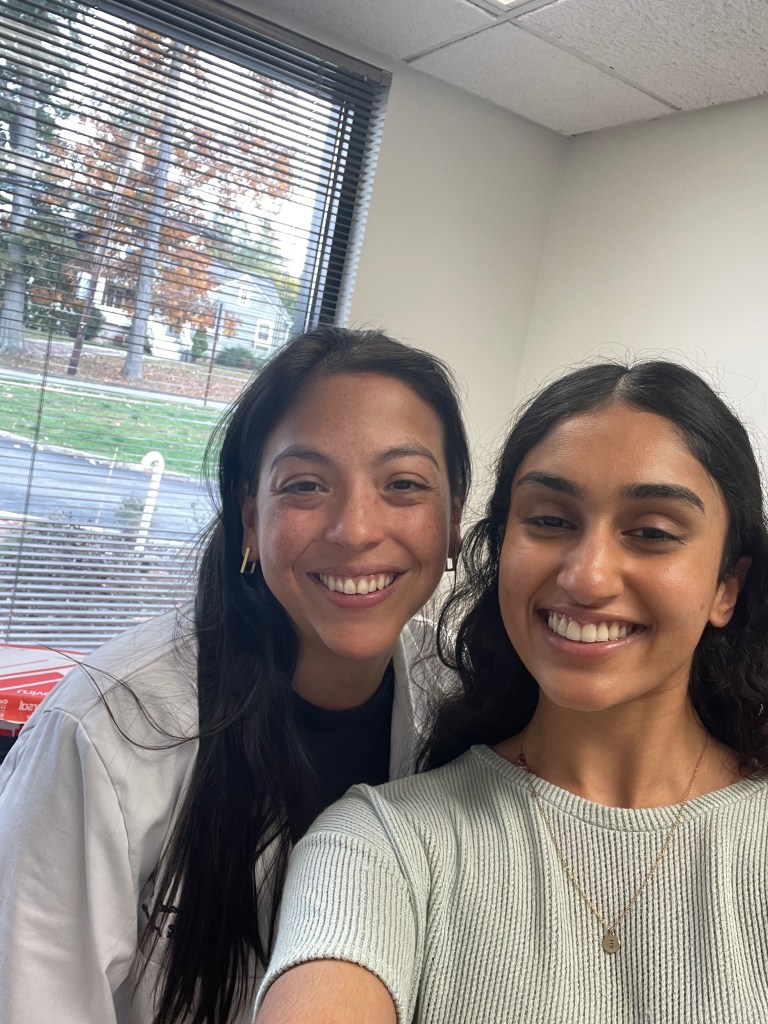
a quick end of shift selfie with Dr. Heidi Godoy!

I was first introduced to the field of podiatry through Dr. Heidi Godoy’s presentation to our AMSA club a couple weeks ago. One of the things she said that stood out to me was: “a lot of people do not understand the importance of our feet – they help us walk and move.” Thus, I emailed Dr. Godoy and asked if I could spend a day shadowing her in her office, to which she immediately agreed! Fun fact: Dr. Godoy is a TCNJ alum!

Dr. Heidi Godoy, DPM, practices at the Alps Family Foot & Ankle, which is a family (and women) run practice composed of Dr. Heidi Godoy and Dr. Johanna Godoy (and previously their mother, Dr Irma Godoy) – girl bosses!

When I first entered the office, Dr. Godoy handed me a white coat (rather casually) and I remember hesitating to take it from her for a quick second because that’s the coat that so many pre-meds hope to wear one day. To be able to wear a white coat, enter a patient’s room, and just be on the other side of medicine was such an insanely wholesome feeling.

Dr. Godoy is simply amazing! Her energy is just so positive and inspiring. Our conversations were fun, educational, and easy. She taught me to not put so much pressure on myself. Everything will work out. Relax.

She also truly is such a boss. Along with handling the clinical side of medicine, she also (rather effortlessly) handled the administrative duties. She was answering patient phone calls, retrieving materials from the storage unit, scribing her charts, responding to emails, and so much more. What a queen.

This shadowing experience taught me more than I thought it would, hence why I wanted to wrap it all up into one blog post so I have a place to refer to this experience.

There are a diverse group of patients that come to a podiatrist. In the 5 hours that I spent at the office, I saw Dr. Godoy interact with patients with all sorts of different conditions that affect the entire lower legs. I’ll recall some patient interactions below and reflect briefly on what their complaint, diagnosis, and treatment plan was (note: the patients are named with letters of the alphabet to abide by HIPAA rules).

  • Patient “A”

Our first patient was an elderly person, who presented with Athlete’s foot and some left foot toenail discoloration. This patient came in with the intention of just getting their toenails trimmed. However, once Dr. Godoy saw the patient’s feet, she recognized that Patient “A” had Athlete’s foot. Luckily, Athlete’s Foot is not a serious condition and is very much treatable. The patient was instructed to apply an anti-fungal cream and ensure that they were wearing shoes that weren’t so tight-fitting.

Afterwards, Dr. Godoy explained to me that some of the older patients come in to get their toenails cut because they are physically unable to do so themselves. This also enables the doctors to examine their feet to ensure that there isn’t any sort of infection or problem with the feet. Watching Dr. Godoy interact with people like Patient “A” was very humbling because it showed me that medicine is not always about the ‘life-changing, cancer-curing’ treatments. Medicine is also about making the ‘everyday’ things more accessible to every single person.

  • Patient “B”

Patient “B” was another adorable older person, who appeared to have mildly painful pressure calluses at the bottom of her foot. It was during this patient interaction that Dr. Godoy taught me about the two pulses that are present in the lower legs. One is called the dorsalis pedis (DP) pulse, which is palpable at the top (or dorsum) aspect of the foot. The posterior tibial pulse is palpable at the intersection between the ankles and heels. Dr. Godoy explained that the latter type of pulse diminishes over time with age due to a lower amount of blood reaching that area (Patient “B” had strong DP pulses, so there appeared to be no concern).

  • Patient “C”

This patient was the first pediatric patient I saw at the office (Dr. Heidi Godoy is also specialized in pediatric podiatry)! Patient “C” came in as a ‘post-op’ and received an XR at the office. This was cool to watch because as a scribe, I only go into patient rooms with the physicians during the initial consultation. I don’t get to see the patients follow through on the orders placed by the physicians. Therefore, being able to see this patient receive an X-Ray was intriguing as I was able to piece together everything from my scribe job. It was also interesting to see the patient get scanned in the office and have the results pop up immediately on the screen. Dr. Godoy pointed out that the area that looks mildly indented is where the patient sustained a trauma injury and fractured that area.

I also learned that toenail fungus is a rather common result of trauma. This patient suffered from a foot injury and as a result came to the office with an obvious fungal infection around the area of trauma.

  • Patient “D”

Patient “D” presented with a fungal toenail infection – their entire big toe was discolored. The patient explained that they get a pedicure regularly and has never seen something like this before. Dr. Godoy explained that nail salons are the main places where people can acquire such fungal infections (wild!).

Nail salons do not sterilize their materials enough (they usually just drop them in some alcohol). Since fungus loves to travel in areas that are moist, dark, and metal, nail salons provide the perfect environment for fungus to grow. Thus, when one gets a gel manicure, the fungus loves to thrive in the darkness under the gel on our toes. *irky*

The cool part about this patient interaction was that I watched Dr. Godoy literally cut off the entire fungal toenail! Not gonna lie, that was a bit difficult to watch because nails, in general, just freak me out. However, the process of actually removing an entire toenail to treat this condition was awesome!

Dr. Godoy then proceeded to explain to the patient that there are usually two forms of treatment for fungal infections: (1) an oral pill or (2) a topical ointment. The patient ended up choosing the topical ointment. Dr. Godoy further explained the process of applying that ointment: it must be applied from the nail bed and cover the entire nail in order to ensure that any residual fungus is being killed.

  • Patient “E”

Patient “E” also presented with a toenail infection. The difference between “E”‘s fungal infection versus “D”‘s was that Patient “E”‘s toenail was not discolored – the nail was just growing thicker. I had no idea that thicker growing toenails could also be a sign of a fungal infection!

Dr. Godoy explained that the treatment for this infection would involve softening the nail first to allow for the antifungal ointment to be able to reach the fungal infection.

Before prescribing the ointment, Dr. Godoy checked the patient’s insurance company. Based on the insurance company, Dr. Godoy offered the patient a different antifungal ointment, which has essentially the same effects as the usually prescribed one. The only reason why Formula 7 (i.e. the antifungal offered to those who do not have insurance that covers Jublia) was the better option for this patient was because it is a lot less cheaper. This showed me that it is crucial that doctors are not single-minded. If multiple patients present with the same symptoms, treatments must be tailored to not only their own somatic needs, but also financial needs.

  • Patient “F”

Patient “F” presented with an ingrown toenail. Dr. Godoy had to perform a partial nail avulsion to treat this patient’s ingrown toenail. She needed to anesthetize the area, for which she mixed a short-acting anesthetic (i.e. lidocaine) and a long-acting anesthetic in the injection. She then proceeded to use a cold spray before injecting the patient’s toe with the anesthetics. Cold sprays are used before the injection to “provide transient anesthesia via evaporation-induced skin cooling, which reduces pain. Results from studies of earlier vapocoolant sprays indicated that they reduced pain due to vaccine injection in children and adults.” Dr. Godoy then injected the patient with the anesthetics. She took a sterilized metal tool and was able to maneuver inside the toe and very elegantly scooped the entire ingrown toenail out. EPIC!

  • Patient “G”

Patient “G,” who has a history of uncontrolled diabetes, presented with a ‘pins and needles’ feeling in their foot. This patient was the perfect example of someone who had fallen through the cracks of the American medical system. They explained how after selling their business, they could no longer afford insurance. Thus, for almost a decade, their health practically deteriorated due to their unfortunate financial constraint.

Upon Dr. Godoy’s examination, it was seen that the patient’s condition is more so a neurological problem than a podiatry related condition. Along with diabetes, the patient explained to Dr. Godoy that they also have history of chronic back pain. Dr. Godoy replied that back pain can also be related to foot pain.

This patient interaction taught me two main things:

(1) Everything in the body is connected to everything in the body. Pain in one area can result in pain in the other area.

(2) Health is often put on the backburner for those who cannot afford to consult a doctor until their conditions become unbearable. How can this situation be better handled so that people are not afraid to go to a doctor during the early stages of their pain/conditions?

  • Patient “H”

Patient “H” presented with heel pain. With a quick examination, Dr. Godoy was able to diagnose the patient with plantar fasciitis. Plantar fasciitis “occurs when the plantar fascia, a strong band of tissue that supports the arch of your foot, becomes irritated and inflamed.” A common sign of this condition (along with heel pain) is having a tight calf.

There were 2 parts to the treatment plan:

  1. Dr. Godoy administered an injection consisting of a corticosteroid (e.g. an anti-inflammatory), short-acting anesthetic (e.g. lidocaine), and a long-acting anesthetic.
  2. The patient was then provided a “Night” splint to help stretch out the calf and release the pressure placed on the heel.

Conclusion

I am ecstatic that I was able to connect with Dr. Godoy and learn some details about podiatry. More than the actual diagnosis and medical part of the learning process, this experience taught me that I have to be open-minded when entering the field of medicine. It sounds so trivial, but I don’t think this is emphasized enough for pre-med students. A lot of us who want to enter the medical field already have this pre-set idea of what medicine ‘looks’ like. However, we do not realize that medicine is so much greater than what we know – it encompasses fields and people from all sorts of different backgrounds.

Note to self: Be open to learning and exploring. Thankful I got to do just that with Dr. Godoy 🙂

Outliers by Malcolm Gladwell

Quick Synopsis: Gladwell takes a look at a person’s background, culture, ancestors, etc. all to explain how they became who they are. For example, Bill Gates is who we know as a successful and wealthy entrepreneur, making him an outlier. However, his success is not attributed to him alone. It’s due to his family, the school he went to, the hours he spent with computers. It’s even due to the year he was born in.

I had so many moments of utter shock while reading this book. Here are some of the things that I learned:

  • It takes 10,000 hours to reach the level of mastery.

Bill Gates reached his level of mastery with computers because he supposedly used his wealthy school’s computers all the freaking time, starting from a young age. Therefore, by the time he developed Microsoft he had already covered or was near to covering 10,000 hours of work.

If we all put in 10,000 hours solely for our passions and into our desired professions, we too would be on the Forbes List.

  • Privilege and power play a large role in your success.

Gladwell talks about Chris Langan, the smartest man in the world. Chris Langan did not have much power or privilege, causing his intelligence and “success” to go largely unnoticed. Gladwell talks about the moment when Chris’s high school teachers didn’t engage him with more challenging work as he was always 100 steps ahead of all of his peers due to his high IQ. Thus, he spent most of his high school time self-studying and eventually earning a perfect score on the SAT.

Langan proceeded to receive scholarships from 2 colleges. He attended one of them and was subsequently kicked out because his mother did not send in his financial information in time. Gladwell even mentions that Langan was denied his request to attend class at a later time because he had a broken down car.

Chris Langan’s opportunities were bare and few, and even when he wanted to act upon them, he couldn’t because of his social background.

There are A LOT of interesting stuff in this chapter that I can’t summarize here, but I HIGHLY recommend reading it so you get as equally shocked!

  • Culture impacts the type of person you are.

There’s this AMAZING chapter about plane crashes and pilots in this book that absolutely blew my mind. In essence, majority of the plane crashes that have occurred can be understood by taking a look at the ethnicities and cultures of the pilots.

Pilots from countries who value elders and authority, tended to not stand up for themselves and the state of their plane minutes before a crash. For example, Gladwell talks about a Colombian pilot who was unable to clearly state to the headquarters that they are out of fuel and needed to land ASAP because he was primed by his culture to never disobey or raise your voice against authoritative figures.

However, an American pilot may have spoken up immediately and demanded that they find a place to land because American culture claims that “all men are created equal.” American culture does not preach the need to bow down to all elders and people of power.

Hence, culture plays a large role in the type of person we are and could become.

Gladwell also talks about how our ancestors and what they did for a living impacts us today. He uses Asians as examples to explain this topic and why they are so good at math. It was incredible. I don’t want to spoil anything hehe 🙂

  • The time and era you were born in can determine your success.

This concept was simply astounding for me. The year and era you were born in can set you up for success or failure. Gladwell talks about how national-level hockey players tend to always be born in the earlier months. He also gives the examples of how all the multi-billionaires were born in the 1950s. Obviously, Gladwell goes more in depth and explains this idea of time to you in this book.

Overall, EVERYONE NEEDS TO READ THIS BOOK to understand that a successful person is not someone who is incredibly different from the rest of us. They are the result of numerous factors that we often overlook.

‘Empty’ Time

My Dad is currently in India on a work trip. When he calls me to check-in, he often asks “What are you doing? What are you up to?”

My go-to reply, with actually anyone who asks a similar question, is “Nothing.”

However, I’m never actually doing ‘nothing’ because doing ‘nothing’ starkly goes against the American Dream: the idea that one must keep hustling in order to achieve their goals and dreams. Doing ‘nothing’ is also terrifying because then that means all the thoughts that I’ve locked away can come back – with full force. Thinking about those thoughts is emotionally draining, so the best solution would be to just go-go-go.

Once you’ve been go-go-go-ing for quite some time, you start to notice how depleted and overloaded you feel. Many define this as ‘burnout.’ A lot of people (and information on the Internet) claim that the cure to burnout is to do things that bring joy. The thing is, though, many people actively schedule those joyful things into their day-to-day lives. The act of scheduling joy may be helpful for some, but I found that it was actually more detrimental for me.

“According to the Western perspective, filling every moment with “value added” activities is a sign of virtue and significance….The archetype of the virtuously over-busy person is so ingrained in our societal mind-set that it takes strong language to knock it loose.” – Martha Beck

When I schedule joy, I start to look at joy as a task that I need to check off. For example, let’s say I schedule “write a blog post at 2:00pm.” Writing and posting on this site is one of my creative passions that brings me lots of joy. However, it only brings me joy when it’s not a structured part of my life. Therefore, when I try to structure this passion of mine into my day-to-day To-Do list, I found that I actually begin to not like writing as much as I used to.

The key to prevent such backward healing is to schedule ’empty time.’

“Empty time is a powerful medicine that can make us more joyful and resilient, but it’s strangely hard to swallow.” – Martha Beck

Schedule ’empty time’ into your calendars. Do not title that block of time with anything – just write ’empty time.’ When you reach that period of time, then decide what you want to do. Do you want to just sit on your ass and stare at the walls? Do you want to journal all your crippling thoughts? Do you want to go out for lunch with your best friend? Do you want to go downstairs and chat with your family? Decide what to do in that moment. Lean in to the things that feel like home. For someone who likes to be in control and plans everything well in advance, this idea of being spontaneous during her ’empty time’ is an uncomfortable, but refreshing feeling.

Martha Beck does an incredible job of conveying the importance of having empty time here.

A New Anxious Discovery

Every time I sit down to begin a project, MCAT practice, or even to write an exam, I begin excessively yawning. In the moment, I used to wonder why I was suddenly overcome with fatigue when I’m actually shitting myself and extremely nervous to complete whatever task I’m about to begin. Yesterday, I was fine all morning and then the excessive yawning began again when I tried to an MCAT practice passage. Curious to see if yawning was somehow related to anxiety, I swiftly googled it. To my surprise, yawning can be a result of nervousness, stress, and anxiety (Wired).

This behavior of excessive yawning is common to almost all of us living beings (i.e. reptiles, animals, humans, fish). According to the article Big Question: Why Do I Yawn When I’m Nervous or Stressed?, researchers found many studies that link yawning to stress. They believe that our hypothalamus, a part of the brain that maintain’s our body’s homeostasis, triggers the behavior of yawning during such stressful situations.

“In one study, male Siamese fighting fish were observed yawning multiple times during different aggressive encounters with one another. Similarly, numerous studies have shown that macaques will yawn in response to various male threats, bouts of sexual jealousy, and anxiety. In a recent study published in Neuroscience Letters, Japanese researchers used classic fear conditioning to successfully induce yawning in rats.” – Wired

One specific reason for this behavior that I found particularly interesting is that yawning can act as a mechanism to maintain our body’s temperature. Under stressful or anxiety provoking situations, we tend to sweat more because of our rising body temperature. Therefore, yawning helps to combat this temperature increase by keeping “the brain at its optimal 98.6 degree temperature.”

“In a 2010 study on the impact of yawning on brain temperature, Gallup implanted probes in the brains of rats and found that even a rise in temperature of 0.18 degrees Fahrenheit triggered yawning. He also found that the skull temperature fell immediately after the rats finished their yawns—sometimes by as much as 0.7 degrees.” – Wired

The next time you catch yourself excessively yawning, instead of reaching for another cup of coffee (like I naively used to do), just check in with your body and note any signs of stress, anxiety, or nervousness.

‘Not All Men Are the Same’: The Telugu Song That Created Controversy Over Its Lyrics

A couple weeks ago, my family and I went to the theatre to watch a Telugu film, called Pushpa. Before the movie released, the song ‘Oo Antava Oo Antava’ (linked above) was released.

First off, Actress Samantha looks absolutely breathtaking in the song as she slays the moves and adds the right amount of attitude to keep up with the lyrics.

A week after we watched the movie, one of my aunts told me that there has been a lot of controversy over this one song from the film. Supposedly, men were offended by the lyrics and a Men’s Association even “filed a lawsuit against the makers of Pushpa and also filed a complaint against them for portraying men in a certain light.

Let’s Talk About the Lyrics

I’m going to breakdown some of the lyrics from this song on the left-hand side of a table, and I’ll breakdown another popular Telugu song (that wasn’t opposed against) on the right-hand side.

‘Oo Antava Oo Antava’ (received a ton of backlash from men for describing the ‘male gaze’)


Potti potti gowney vesthey Patti patti choostharu

When she wears short clothes, They’ll [men] drool all over them [women]

Mee kallallone anthaa undhi
Mee maga buddhe vankara buddhi

Your [men] eyes say it all. The male mentality is a twisted mentality

Thella thellagunte okadu
Thallaakindhulauthaadu
Nalla nallagunte okadu
Allarallari chesthaadu
Telupu nalupu kaadhu meeku
Rangutho pani yemundhi
Sandhu dorikindhante saalu
Mee maga buddhey vankara buddhi

When she’s fair-skinned, One man is mesmerized. When she’s dark-skinned, Another man goes crazy. It doesn’t matter if she’s fair or dark, They [men] just need a chance. The male mentality is a twisted mentality.

‘Ninne Ninne’ (received no backlash from men for sexualizing a woman)


Before breaking down some lyrics, let’s analyze the scene that comes before the song.

Notice at 1:26, when the girl asks “Do you love my heart or my body?” the guy immediately responds “the body because I don’t know your heart. You look gorgeous; a great smile, a fantastic skin tone. That’s all I need.

The girl tries to make him understand that our bodies should not define us and we are so much more than that. To that, the man vulgarly asks (at 2:26) “Will you have sex with me tonight?” to taunt the girl’s previous statement. He then breaks out into a song that essentially stalks the girl and sexualizes her body.


Devudichina andalu ayyo papam paruvalu
Cheyyamake matti paalu chuttukuntay papalu
Nuvvu leka ne lene ninnu vidichi polene
Neellu leni bavilona duki nenu chasthane
Inave nuv inave ose inave ehe inave..
Ninne ninne.. Ninne ninne… Ninne ninne… Ninne…

God has given you so much beauty, and yet you’re still a virgin. Don’t waste that beauty; you’ll become a sinner. I’m nothing without you; I can’t leave you. I’ll jump in a well without water, Listen to me, hey! Listen to me!

Note: There is a clear portrayal of sexism in both songs. In ‘Oo Antava Oo Antava,’ there’s a classic depiction of “men leering at a woman as she sways, slides and drapes herself over the hero, while a camera constantly cuts to bared bits of her body.” In ‘Ninne Ninne’ the man is aggressively yelling and, at one point even, pretends to hit the woman (4:00). Oh and let’s not forget him blackmailing the girl that he’ll essentially kill himself (i.e. “I’ll jump in a well without water”).

‘Oo Antava Oo Antava’ targets men for treating women the way they do; whereas, ‘Ninne Ninne’ is targeting women for not succumbing to the man stalking, verbally abusing, and sexualizing her. Despite this irony, the former song is the one that received so much backlash. Do we see how this is a clear problem?

Many men were supposedly offended that they were depicted as such people, leading to many to use the impeccable phrase “Not all men are like that.”

  • “So #NotAllMen doesn’t clarify anything. It doesn’t add to the discussion or develop it in any way. All it does is derail and dismiss the lived experiences of women and girls. And what the men who leap to remind us that ‘’not all men are like that’’, are actually saying is, ‘’I’m not like that.’’ Or to put it another way, they are letting women know that discussing misogyny makes them uncomfortable, and they’d like to be absolved of any blame before they will let women continue.
  • If you are a man and don’t recognise yourself in the behaviour described by women recently, then great. Our discussion of it shouldn’t offend you, or put you on edge. The men who are behaving like allies in this are the ones that are amplifying women’s voices, examining their own behaviour, and not drowning out our conversations in search of praise or validation.” – Medium

A woman is allowed to wear whatever she wants, dance in whatever way she wants, and look the way she wants.

Many aunties and grandmas I know have said “I don’t like how vulgar Samantha looks in that song” or “Why is she wearing that, exposing all of her body like that?”

It’s 2022 people; get over it!

If it’s okay for you to watch men, like Salman Khan, dance shirtless, then it is equally okay for a woman, like Samantha, to wear what she’s wearing and absolutely slay on screen!

It’s not okay, however, that men are seldom sexualized or taunted for wearing or looking the way they do, whereas women are constantly sexualized for doing the same exact freaking thing.

Conclusion

The point of this long-winded post was:

  1. The male ego got super butt hurt after ‘Oo Antava Oo Antava’ was released because it explicitly called men out on their behaviors.
  2. Create songs that don’t sexualize women. People fantasize and imbibe what they see on screen, especially in India, since the celebrity craze is extra hyped. Therefore, it’s crucial to send the correct messages through these films.
  3. Samantha is a freaking queen and should not be criticized for wearing what she wore and looking the way she did in the song.

Creative Living is Extraordinary

This was a refreshing and encouraging read. 

Quick Synopsis: Elizabeth Gilbert talks about the importance of creative living. The importance of chasing curiosity, not wallowing in failure, and recognizing that creative living is the only way to live. 

The most interesting part of this book was when Gilbert talked about her idea to write a book about the Amazon jungle. The idea just came to her and she was ecstatic and completely imbibed in the process of writing that book. However, unexpected events in her life came in the way and hindered the completion of that book. Years later, Gilbert meets one of her author friends, who shares a book idea that she got. The friend repeats the same plot and idea that Gilbert had had with her Amazon jungle story. HOW INSANE! 

We often think that ideas are our own. After reading this book, I realize that ideas do not belong to us – we do not create them. Ideas are alive entities and they find that one right person who will bring them to life. 

That’s exactly what happened with Gilbert. The idea of the Amazon jungle novel chose Gilbert initially, but when it realized that Gilbert would no longer be able to birth it to life, it chose a different human to do the job. What an incredible finding! 

I often get scared that someone will do something before me. I have ideas and projects in mind, so I worry that someone will beat me to it. I will proceed to internalize it if someone does beat me to it. 

Note to self after finishing this book: Someone has already done something that you wanted to do because there are only so many things to be done. But no one has done that something the way that you will or have done that something – and this, is the beauty of our human existence. 

It’s okay if the same idea that found us traveled away from us and found someone else to fulfill it. We need to realize that either we were not fully ready to do justice for that project or that we can still keep going with the idea and do it in our own way (that is, only if we are still extraordinarily passionate about it). 

All in all, this was an incredibly thought-provoking book that made me reframe the way I’ve thought about life. It’s also provided me with some answers on how to handle my envy of others. 

I would definitely recommend this for anyone who feels as though they are “stuck,” have no purpose, jealous, or just want to learn how to notice the signs that the Universe continues to bombard us with everyday.

Why the Physician Mental Health Questionnaire is Ineffective for Adolescents

Whether it be for a sick visit or an annual check-up, my doctor’s office always has me fill out a “Mental Health Questionnaire.” The questionnaire essentially consists of numerous statements with a scoring criteria. For example, one statement could be written as “feeling nervous, anxious, or on edge” and the right hand columns will have a 0 for “not at all,” 1 for “several days,” 2 for “more than half the days,” and 3 for “nearly every day.” As I circle a number for each statement, I arrive at the end where I am required to tally up the numbers and give myself a score. 

This questionnaire has been a recent requirement, which I appreciate as it shows that mental health is becoming more of a priority in medicine. However, there are a couple drawbacks to this that I feel defeats the whole purpose of having pediatric patients fill this out. 

For starters, minors are accompanied by their parents for these doctor visits. Therefore, parents are sitting next to them when children fill out these questionnaires. It can sometimes be uncomfortable and hard to honestly answer the questions because there’s a high probability that our parents are looking over our shoulders to see what we’re writing down. This automatically skews the answers and deems the questionnaire ineffective. 

The other major con of this questionnaire is that most doctors don’t even look at it or mention it during the visit. Out of all the years I’ve been required to fill this out, only one doctor took the time to send my mom out of the room and talk to me about my answers. The rest of the physicians didn’t even look at my responses.

What does this convey to pediatric patients? 

When the physicians didn’t even bother to take a few minutes to check in with how I was doing mentally, it conveyed to me that getting my ears, eyes, heart, and the rest of my body was more important to them than understanding the way I was feeling mentally. 

It also showed me that physicians may not be taught medicine from a holistic standpoint. Especially in the U.S, medicine is more about analyzing a patient’s somatic symptoms and arriving at a diagnosis for further treatment. Therefore, physicians are likely to overlook symptoms of depression, anxiety, suicidal tendencies, bipolar disorder, etc. because they are so focused on the issues of the physical body.  

The questionnaire was a great starting point to prioritize mental health in medicine. However, it is now time to step it up a notch. This could be done by requiring doctors to take time out of the visit to have conversations about mental health. This, not only will help children who recognize that they are mentally struggling, but will also raise awareness for the children who are not aware of mental health and mental illnesses. 

Valentine’s Day and Chocolate = Child Labor?

This post was published on https://satyarthi-us.org/valentines-day-and-chocolate-child-labor/. As an intern for the 100 Million and Kailash Satyarthi Children’s Foundation, I got to research and write this little piece for their website!

Every year as part of a Valentine’s Day fundraiser, chocolate bars were distributed. I have always cherished the memory of my friends and I nibbling on the delicious chocolate bars. It wasn’t until recently that those Valentine’s Day memories were tarnished after I discovered that as we ate the sweet bites of chocolate at school, millions of children were missing out on their education, laboring in harsh conditions to provide our chocolate. It was astonishing to read that it wasn’t just my high school that bought a ton of chocolate during this week. Americans from all over the country buy nearly 58 million pounds of chocolate during the week of Valentine’s Day.

Chocolate is made from cocoa beans, and it is in the growing and harvesting of these beans that child labor is taking place. Nearly 70% of cocoa beans come from West Africa including Ghana, Ivory Coast, Nigeria, and Cameroon. Many children in these countries are born into cocoa farming families. As a result, starting from a young age, they are thrown into the vicious cycle of sacrificing their childhood and education to produce the chocolate that is exported to other countries, including the US. Those who aren’t born into cocoa families are not spared; some children become victims of child trafficking as they are kidnapped and taken to cocoa farms.

The chocolate industry is one the largest industries in the world, expected to reach $139.94 billion by 2024. With increases in cocoa production out of West Africa, the use of child labor grows with it.

WHY IS THIS IMPORTANT?

International Conventions, ratified by most countries, prohibits child labor and ensures the rights of children. The Convention on the Rights of the Child says that all countries must ensure that children are protected, given access to education and healthcare, given room to grow, and are informed and participate in achieving their own rights. International Labor Organization’s Convention 182, bans the worst forms of child labor. Child labor prevents children from gaining the education that they deserve as they spend more time working than being in school. Forcing children to perform labor instead of gaining knowledge is innately cruel and sacrifices their future.

In addition to not gaining an education, children on cocoa farms are forced to be in perilous situations. For example, many children “use chainsaws to clear the forests….[and others] climb the cocoa trees to cut bean pods using a machete.” Additionally, after using those tools, they are even forced to carry the cumbersome sacks of bean pods, weighing nearly 100 pounds, on their backs across the forests, risking permanent damage. Along with physical injuries, children involved in cocoa production are susceptible to pesticide poisoning. Supposedly, children learn how to “mix, load, and apply pesticides as young as age 12.” Constant exposure to these perilous pesticides can lead to respiratory paralysis and even death. Protective clothing is required when people come in contact with pesticides, however, children are almost never taught or given personal protective equipment to prevent harm.

It is evident that children working in cocoa production are subject to physical harm, if not death, but they are also more prone to mental illnesses. Children who began to work at the ages of 10-14 showed a higher risk of developing depression as compared to the children who started working at the ages of 15-17. This shows that the younger a child starts working, the greater their risk of developing mental health conditions in adulthood.

WHAT CAN WE DO?

One way to help eradicate child labor in cocoa production is to pressure our governments to intervene to protect children from working on cocoa farms. In the US, Section 307 of the Tariff Act of 1930 prohibits the importation of goods into the country produced using forced or indentured labor, including forced child labor. After allegations of possible child labor on the Ivory Coast cocoa farms in 2019, the US government is working with cocoa producing countries and companies to determine their course of action in addressing child labor in our chocolate.

Apart from working with governmental authorities, we have the power to directly pressurize the chocolate companies. Take action with Green America and call on the world’s ten biggest chocolate companies to put an end to child labor in cocoa and deforestation! When doing your own shopping, check your products against Green Americas chocolate scorecard or Slave Free Chocolates list.  When we come together, our voices are amplified and we reach one step closer to protect every child from the dangers of working on cocoa farms.

For more information, read Assessing Progress in Reducing Child Labor in Cocoa Growing Areas of Côte d’Ivoire and Ghana by NORC at the University of Chicago.

Esha Kode is an 18 year old premed student at The College of New Jersey, studying psychology and hopes to become a pediatric surgeon. She is a pageant title-holder, TEDx organizer, and the cofounder of a 501(c)3 nonprofit organization. Esha is a 100 Million activist and she is excited to work with a team whose primary goal is to eradicate child poverty!