‘b****’: let’s unpack it.

Those of you who have been here a while know that I am a podcast fanatic. I have recently been hooked to Meghan Markle’s Archetypes, which dissects and explores the tropes and labels that have been or are still used to hold women back.

In her recent episode, Meghan sat down with Andy Cohen, Executive Producer of the Real Housewives franchise. Andy mentioned in the episode that one woman in the Real Housewives franchise wanted to use the b-word in her tagline. The word was not approved, however, Andy mentioned that the woman did make her case for why she does not feel offended by the use of that word. On the other hand, Meghan analyzed the b-word and how it was used to belittle women in the past during one of her previous episodes. She was shocked to hear that people from the current generation don’t mind the b-word because it’s used so often. Some also claimed that the b-word is easier to bear compared to all the other words/labels being thrown around today.

I was first introduced to the b-word in elementary school. In fact, I was considered to be one of the “late users” of the word. I didn’t begin using it until around eighth grade because at that point I had heard all of my fellow classmates use it so regularly, so obviously my 14-year-old self adapted to her social environment.

Here’s a confession: Today, I tend to use this word more often and with many of my friends. The b-word is a common vocabulary term that we use to sometimes greet each other, express anger, describe something, etc. However, I don’t think many of us realize that there is such a deep-rooted sexist history to the word. Thus, hearing Meghan Markle describe the b-word as a demeaning label for women was a shock to me, prompting me to research all about it.

what does it mean.

A “bitch” supposedly means a female dog. I’m not sure if this was common knowledge or not, but I simply had no idea or I was just oblivious to the fact that there is an actual definition of this word in the dictionary.

a quick history lesson.

The use of the b-word originates back to the 1400s (Hodgson, 2008). Apparently, calling a woman a b**** was used to accuse her of “being worse than a prostitute because at least a prostitute stood to gain financially from the broad distribution of her sexual favors” (Hodgson, 2008). Let’s pause really quick. Coffee date #5 is a strong advocate for substituting the word ‘prostitute’ with ‘sex workers’ or ‘sex professionals’ because it accepts/validates their labor. Therefore, it is crucial to note that the b-word is seen as something worse than, yet another, sexist, belittling label.

There’s also a link to the b-word and the Greek Gods. Supposedly, the Greek goddess Artemis-Diana, who was the goddess of the hunt, was often depicted as being in the presence of dogs. To spread Christianity and suppress the idea of a female being idolized, Christian Europe used the phrase ‘son of a bitch’ to criticize those who believed in Artemis-Diana (Kleinman et al., 2009). Therefore, this showed that the term ‘bitch’ was used to eradicate images of powerful and capable women by “equating them with sexually depraved beasts” (Kleinman et al., 2009).

why it is used.

Kleinman et al. states that “feminists analyzed that preference [the need to use ‘bitch’ over any male-associated terms, such as ‘jerk’ or ‘dickhead’] as internalized oppression, whereby members of an oppressed group learn to enjoy using the dominant group’s term for them” (2009). *jaw dropped. eyes bulged. gasped for a hot second.*

how it is used.

As mentioned previously, my friends and I tend to use this word nonchalantly. Some of us even use it to describe objects or events. For instance, let’s say we take an incredibly hard exam. Many might say that that “exam was a real bitch.” Others who still struggled through the exam, but felt that they did well might say “I bent that test over and made it my bitch” (these example quotes were taken from the Kleinman et al. paper).

In the former example, the b-word is being associated with “difficult” – yet another label often used to belittle women. In the latter example, the b-word is being associated with something that can be controlled, dominated, or conquered (Kleinman et al., 2009). And for how long have women been controlled and dominated in our largely patriarchal world?

Therefore, the paper noted that using the b-word over any other terms associated with men or masculinity (for example, people rarely say ‘that exam was a real jerk‘) to describe objects is further indicates just how abusive the b-word is towards women and how its use is fueling sexism.

The b-word is also often used in the political space, especially during heated debates and in media articles. During the 2008 primaries in the United States, Sarah Palin was supposedly “viewed as emasculating John McCain, who was then labeled a “bitch” in a comedic YouTube clip titled, “Is McCain Palin’s Bitch?”” (LisaNova, 2008). The fact the b-word was being used to describe a man, a white man nonetheless, immediately displays that its purpose was to ’emasculate’ him. It was also intended to insult the man for allowing himself to be dominated by a woman *insert dramatic eye roll* (Kleinman et al., 2009).

the conclusion.

Honestly, Kleinman et al.’s paper Reclaiming Critical Analysis: The Social Harms of “Bitch” has been incredibly insightful and eye-opening (2009). It shed light on exactly why the b-word is so offensive and why Meghan Markle was so confused as to why this term is such a normal part of millennial vocabulary.

Words hold so much power. They can be healing, grounding, and therapeutic. Yet they can also be sexist, demeaning, and continue to fuel all the labels and stereotypes attributed to different genders, races, classes, and people in general. Thus, we must choose our words carefully and accept it when we are oblivious to terms that are harmful and degrading. From acceptance, we must move towards change and that change can stem from something as simple as conscientiously removing such terms from our vocabulary.

Here are some other related articles and resources I found for any of you interested folks:

  1. Use of the word “bitch” surged after women’s suffrage (Zhou, 2020)
  2. What’s so bad about being called a ‘bitch’? (Taylor-Coleman, 2016)
  3. The Harmless-Sounding Phrase That Is Terrible for All Women (Rinaldi, 2017)

podiatry. what is it?

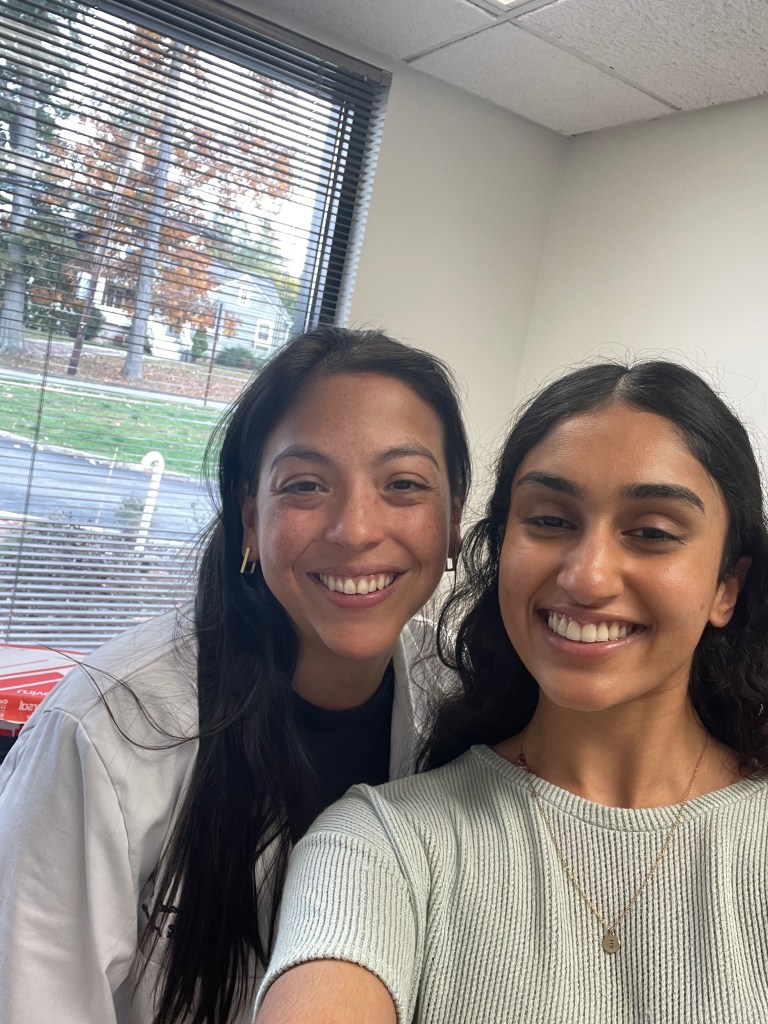
a quick end of shift selfie with Dr. Heidi Godoy!

I was first introduced to the field of podiatry through Dr. Heidi Godoy’s presentation to our AMSA club a couple weeks ago. One of the things she said that stood out to me was: “a lot of people do not understand the importance of our feet – they help us walk and move.” Thus, I emailed Dr. Godoy and asked if I could spend a day shadowing her in her office, to which she immediately agreed! Fun fact: Dr. Godoy is a TCNJ alum!

Dr. Heidi Godoy, DPM, practices at the Alps Family Foot & Ankle, which is a family (and women) run practice composed of Dr. Heidi Godoy and Dr. Johanna Godoy (and previously their mother, Dr Irma Godoy) – girl bosses!

When I first entered the office, Dr. Godoy handed me a white coat (rather casually) and I remember hesitating to take it from her for a quick second because that’s the coat that so many pre-meds hope to wear one day. To be able to wear a white coat, enter a patient’s room, and just be on the other side of medicine was such an insanely wholesome feeling.

Dr. Godoy is simply amazing! Her energy is just so positive and inspiring. Our conversations were fun, educational, and easy. She taught me to not put so much pressure on myself. Everything will work out. Relax.

She also truly is such a boss. Along with handling the clinical side of medicine, she also (rather effortlessly) handled the administrative duties. She was answering patient phone calls, retrieving materials from the storage unit, scribing her charts, responding to emails, and so much more. What a queen.

This shadowing experience taught me more than I thought it would, hence why I wanted to wrap it all up into one blog post so I have a place to refer to this experience.

There are a diverse group of patients that come to a podiatrist. In the 5 hours that I spent at the office, I saw Dr. Godoy interact with patients with all sorts of different conditions that affect the entire lower legs. I’ll recall some patient interactions below and reflect briefly on what their complaint, diagnosis, and treatment plan was (note: the patients are named with letters of the alphabet to abide by HIPAA rules).

  • Patient “A”

Our first patient was an elderly person, who presented with Athlete’s foot and some left foot toenail discoloration. This patient came in with the intention of just getting their toenails trimmed. However, once Dr. Godoy saw the patient’s feet, she recognized that Patient “A” had Athlete’s foot. Luckily, Athlete’s Foot is not a serious condition and is very much treatable. The patient was instructed to apply an anti-fungal cream and ensure that they were wearing shoes that weren’t so tight-fitting.

Afterwards, Dr. Godoy explained to me that some of the older patients come in to get their toenails cut because they are physically unable to do so themselves. This also enables the doctors to examine their feet to ensure that there isn’t any sort of infection or problem with the feet. Watching Dr. Godoy interact with people like Patient “A” was very humbling because it showed me that medicine is not always about the ‘life-changing, cancer-curing’ treatments. Medicine is also about making the ‘everyday’ things more accessible to every single person.

  • Patient “B”

Patient “B” was another adorable older person, who appeared to have mildly painful pressure calluses at the bottom of her foot. It was during this patient interaction that Dr. Godoy taught me about the two pulses that are present in the lower legs. One is called the dorsalis pedis (DP) pulse, which is palpable at the top (or dorsum) aspect of the foot. The posterior tibial pulse is palpable at the intersection between the ankles and heels. Dr. Godoy explained that the latter type of pulse diminishes over time with age due to a lower amount of blood reaching that area (Patient “B” had strong DP pulses, so there appeared to be no concern).

  • Patient “C”

This patient was the first pediatric patient I saw at the office (Dr. Heidi Godoy is also specialized in pediatric podiatry)! Patient “C” came in as a ‘post-op’ and received an XR at the office. This was cool to watch because as a scribe, I only go into patient rooms with the physicians during the initial consultation. I don’t get to see the patients follow through on the orders placed by the physicians. Therefore, being able to see this patient receive an X-Ray was intriguing as I was able to piece together everything from my scribe job. It was also interesting to see the patient get scanned in the office and have the results pop up immediately on the screen. Dr. Godoy pointed out that the area that looks mildly indented is where the patient sustained a trauma injury and fractured that area.

I also learned that toenail fungus is a rather common result of trauma. This patient suffered from a foot injury and as a result came to the office with an obvious fungal infection around the area of trauma.

  • Patient “D”

Patient “D” presented with a fungal toenail infection – their entire big toe was discolored. The patient explained that they get a pedicure regularly and has never seen something like this before. Dr. Godoy explained that nail salons are the main places where people can acquire such fungal infections (wild!).

Nail salons do not sterilize their materials enough (they usually just drop them in some alcohol). Since fungus loves to travel in areas that are moist, dark, and metal, nail salons provide the perfect environment for fungus to grow. Thus, when one gets a gel manicure, the fungus loves to thrive in the darkness under the gel on our toes. *irky*

The cool part about this patient interaction was that I watched Dr. Godoy literally cut off the entire fungal toenail! Not gonna lie, that was a bit difficult to watch because nails, in general, just freak me out. However, the process of actually removing an entire toenail to treat this condition was awesome!

Dr. Godoy then proceeded to explain to the patient that there are usually two forms of treatment for fungal infections: (1) an oral pill or (2) a topical ointment. The patient ended up choosing the topical ointment. Dr. Godoy further explained the process of applying that ointment: it must be applied from the nail bed and cover the entire nail in order to ensure that any residual fungus is being killed.

  • Patient “E”

Patient “E” also presented with a toenail infection. The difference between “E”‘s fungal infection versus “D”‘s was that Patient “E”‘s toenail was not discolored – the nail was just growing thicker. I had no idea that thicker growing toenails could also be a sign of a fungal infection!

Dr. Godoy explained that the treatment for this infection would involve softening the nail first to allow for the antifungal ointment to be able to reach the fungal infection.

Before prescribing the ointment, Dr. Godoy checked the patient’s insurance company. Based on the insurance company, Dr. Godoy offered the patient a different antifungal ointment, which has essentially the same effects as the usually prescribed one. The only reason why Formula 7 (i.e. the antifungal offered to those who do not have insurance that covers Jublia) was the better option for this patient was because it is a lot less cheaper. This showed me that it is crucial that doctors are not single-minded. If multiple patients present with the same symptoms, treatments must be tailored to not only their own somatic needs, but also financial needs.

  • Patient “F”

Patient “F” presented with an ingrown toenail. Dr. Godoy had to perform a partial nail avulsion to treat this patient’s ingrown toenail. She needed to anesthetize the area, for which she mixed a short-acting anesthetic (i.e. lidocaine) and a long-acting anesthetic in the injection. She then proceeded to use a cold spray before injecting the patient’s toe with the anesthetics. Cold sprays are used before the injection to “provide transient anesthesia via evaporation-induced skin cooling, which reduces pain. Results from studies of earlier vapocoolant sprays indicated that they reduced pain due to vaccine injection in children and adults.” Dr. Godoy then injected the patient with the anesthetics. She took a sterilized metal tool and was able to maneuver inside the toe and very elegantly scooped the entire ingrown toenail out. EPIC!

  • Patient “G”

Patient “G,” who has a history of uncontrolled diabetes, presented with a ‘pins and needles’ feeling in their foot. This patient was the perfect example of someone who had fallen through the cracks of the American medical system. They explained how after selling their business, they could no longer afford insurance. Thus, for almost a decade, their health practically deteriorated due to their unfortunate financial constraint.

Upon Dr. Godoy’s examination, it was seen that the patient’s condition is more so a neurological problem than a podiatry related condition. Along with diabetes, the patient explained to Dr. Godoy that they also have history of chronic back pain. Dr. Godoy replied that back pain can also be related to foot pain.

This patient interaction taught me two main things:

(1) Everything in the body is connected to everything in the body. Pain in one area can result in pain in the other area.

(2) Health is often put on the backburner for those who cannot afford to consult a doctor until their conditions become unbearable. How can this situation be better handled so that people are not afraid to go to a doctor during the early stages of their pain/conditions?

  • Patient “H”

Patient “H” presented with heel pain. With a quick examination, Dr. Godoy was able to diagnose the patient with plantar fasciitis. Plantar fasciitis “occurs when the plantar fascia, a strong band of tissue that supports the arch of your foot, becomes irritated and inflamed.” A common sign of this condition (along with heel pain) is having a tight calf.

There were 2 parts to the treatment plan:

  1. Dr. Godoy administered an injection consisting of a corticosteroid (e.g. an anti-inflammatory), short-acting anesthetic (e.g. lidocaine), and a long-acting anesthetic.
  2. The patient was then provided a “Night” splint to help stretch out the calf and release the pressure placed on the heel.

Conclusion

I am ecstatic that I was able to connect with Dr. Godoy and learn some details about podiatry. More than the actual diagnosis and medical part of the learning process, this experience taught me that I have to be open-minded when entering the field of medicine. It sounds so trivial, but I don’t think this is emphasized enough for pre-med students. A lot of us who want to enter the medical field already have this pre-set idea of what medicine ‘looks’ like. However, we do not realize that medicine is so much greater than what we know – it encompasses fields and people from all sorts of different backgrounds.

Note to self: Be open to learning and exploring. Thankful I got to do just that with Dr. Godoy 🙂

texts that make me 🥺.

I freaking love that I was born in the 21st century and have access to technology. Specifically, I love that I have access to my cell phone. I do so much on my phone – from taking pictures, setting up calendar notifications, replying to emails, scrolling through Instagram, posting my BeReals, etc.

Most of the time I’m beating myself up over the fact that I spend so much freaking time on my phone (during one college seminar, I was told that research says that we should only be spending 30 minutes a day on our phones. please 😭 I could never). However, those once-in-a-blue-moon days I have someone, who I haven’t spoken to in ages, text me and say “hey! how are you? i was thinking we can grab some brunch or coffee one day when you’re free?” I become ecstatic.

Envision an extremely cheesy and smiley teddy bear running around in circles. That’s me when I receive those kinda texts. It’s the fact that someone thought of me and they wanted to take their precious time out of their day to share that time with me that gets me so senti and amped up.

This is exactly why I am so obsessed with my fifty coffees because it’s usually one of those people that reaches out months later. This shows me that spending that intentional time with people makes them feel seen and valued, so they will always (or oftentimes) try to make space for that intentional time again and again.

This is your sign to text that person you’ve been meaning to text, but life kept getting in the way, that you wanna hang with them and grab a cup of coffee (or a beverage/meal of your choice). Go. Do it. Send me (on IG: @_esha.kode_) a picture of that text (if you feel like it) because I would love to see these authentic & raw connections that we’re building with each other!

that person.

Last week, I had an epiphany.

I was always one of those people who said “I don’t need to see people all the time. I don’t like people. I like picking up from where we left off.”

I realized that every time I said that I was bullshitting myself and the people I was saying that to.

After Shivdaballer entered my life, a lot changed. I had never felt such an incredible connection with anyone else up until that point.

Shivdaballer is in the 7-year medical program, meaning she graduated after 2 years of undergrad (unfortunately for me). Since we ended high school and began college during the pandemic, I only met her when we were allowed back on campus – our sophomore year. This meant that I literally only had one year to cultivate a relationship with her, get unbelievably close, and then bid her goodbye.

Here I am now, my junior year of college – no longer conquering the campus with Shivdaballer. Meeting and connecting with someone on such a deep level and then suddenly realizing that that person will always stay in your life, but will not be with you for the next two years of your undergrad life hits hard. It cuts deeper when I see other people deepening their relationships because I find myself getting jealous that they get to have that extra time. My cousin put it this way, “You’re grieving the time you couldn’t have. It is normal to feel that way.”

There’s a reason why it took me much longer to get readjusted to the college life after Shivdaballer left compared to when I lost touch with many of my high school friends as I transitioned into college. Shivdaballer taught me a lot – a lot about life, a lot about myself.

The biggest thing she taught me, though, is to just not take myself so seriously. I used to always get hung up over the littlest things in life. Oftentimes, I’d be afraid of how I’ll be perceived; sometimes I’d freak out over academics. Shivdaballer showed me that really none of that matters. It’s important to work our butts off to get to where we want, but she made me realize that I can have everything and anything I want without ruining myself. She also taught me to embrace every inch of who I am. There were so many times when we’d walk out of our apartment wearing the most shittiest clothes and strut through campus without a care in the world because she showed me that people don’t care, and those who do, don’t matter.

There’s a long list of lessons and realizations that I can continue to write about, but my point in writing this post is to remind myself (and everyone else reading) that many people will come and go. However, there will be some who will come, stay, and be the main people at your Wedding Party. Shivdaballer is one of those who will always stay in my life and will be the wacko taking shot after shot with me at my wedding. It’s comforting to know that we can meet people at any time, especially during the most unexpected times, and they will just uproot our lives for the better.

Love you Shivdaballer ❤

when you feel like the world is ending…

inspired by Lana Blakely’s video.

writing this post to remind myself of all the things that keep me sane – it’s a never-ending list and something that I can always refer to on the days I feel gloomy 🙂

when you feel like the world is ending, think of these:

the soggy, muddy grass against your feet after the sprinklers have just turned off.

the smell of your morning cup of coffee as the warmth of it spreads across your face.

the sinking feeling of your heart when you’re at the top of the swing on the playground.

the way your brother smothers you with his entire body when you just want to lay down and Netflix.

the way your cousin sits and listens to every one of your words when you need someone the most.

the view of the sky connecting with the height of the trees during your long car rides.

the smell of your brother’s fart in the car prompting you to roll all the windows down and let the smell of nature fill the air.

the way you wake up to the annoying, yet soothing chirps of the birds.

the sound of shawn mendes or b praak making you want to release all that you have bottled up for weeks.

the feeling of the spring wind against your skin causing your little hairs to shoot up.

the redness and pulsing of your heart after a challenging and invigorating workout.

the tears and wholeheartedness you feel after watching dear zindagi for the millionth time.

the random hugs, slaps, and spicy fries sponsored by shivdaballer.

the kind souls you’ve met because of the fifty coffees.

the bubble tea in princeton.

the love the family in houston showered you with.

the dream of saving so many lives once you become a surgeon.

the sound of glennon doyle in your ear telling you to just sit still and find your ‘knowing.’

the fierce eyes of a lion on top of a mountain.

the smelly armpits of your brother and ravali that suffocate you during a movie night in the basement.

the idea that life is very vast, but you live day by day.

the average life span is around 80 years and you’re only 20. only 20.

the fact that you have a blog and you pour your heart out in these posts and coffee dates.

the taste of nani’s warm rasam rice mixed with spicy chicken curry.

the understanding that you are enough and everything happens for a good reason.

the sound of the waves of the ocean aligning with the beat of your heart.

Bodies, Bodies, Bodies

Thankful to all of YOU who have showered this post with so much love ❤ This post, in particular, took a lot of courage to publish and I’m grateful that it resonated with so many of you.

I truly love the fam that we’re creating on this site and am incredibly happy that I decided to embark on this blogging journey. Blogging is something I do to just unleash my emotions – this site acts as my digital diary. Every post comes straight from my heart and I am beyond joyous that many of you are taking the time to read my words. Sending you all so much love!

Esha Kode's avatarEsha Kode

In all honesty, I was terrified to draft and publish this blog post because it’s forcing me to write down and reflect on my CURRENT thoughts. All my other posts are generally things that I’ve dealt with and thought about in the past, so it’s easier to reflect because I moved past that stage already. This topic, on the other hand, seems to always be a part of me no matter how hard I try to move past it. Thus, I was prompted to draft this post because I’ve been feeling this way since the beginning of this year. I hope it resonates with those of you who feel a similar way.

TW: body image issues, eating disorders

To begin, my first exposure to the Eurocentric ideas of a woman’s body began in eighth grade (which is, unfortunately, extremely late compared to children today). Up until eighth grade, I ate…

View original post 1,206 more words

Physical Touch

I was known for being the “Touch Me Not” child while growing up. When all our relatives used to visit, they’d squeeze my cheeks, bring me in for a hug, and hold my hand while speaking. I remember never really liking that physical touch. I was never a hugger nor a fan of physical touch. Many of my coffee dates can attest to that.

This past weekend, however, I somehow enjoyed the hugs, kisses, and the touch.

This weekend, I met new faces and rekindled relationships with so many of my family members. This environment was unlike any other family environment I’ve been in. These people were just exuding so much love and had no other ulterior motives other than to just shower me with as much kindness as possible. Not a single person was toxic and no one gave off any sort of negative vibes.

Many of these people were grandparents and aunts & uncles I met when I was just a kid. They held my hand affectionately in their hands as they spoke about their lives – some would even go on to speak about their own marriages, life trajectory, and their kids. My heart was jumping in joy as I reconnected with so many of these wonderful souls and learning that love can be a very beautiful feeling.

Now, as I am reflecting, I realize that the reason why I was never a fan of touch was because my parents never showed their love through physical touch. I wasn’t used to it and I didn’t understand it, which is why when others prefer this love language, I oftentimes have no idea how to react.

I will now no longer avoid those intimate moments with people I love because I realize that I enjoy this kind of love – the love that doesn’t need to be shown through words or money or large actions. It makes my heart giggle and makes me wanna say ‘ily‘ to the people in my life who make my world so happy.

A Colored Person’s Invisible Insecurity

There’s a familiar lump in my throat and weird squiggles in my stomach as I am writing this post. The content in this post has been largely unspoken about or said to any of my friends or family. Thus, knowing that once I finish, I’ll hit the “Publish” button is absolutely terrifying.

This post is about a colored person’s insecurities.

The insecurities that arise when you’re in a public place, such as your workplace, and you start having pounding palpitations when it’s time to open your Tupperware because you’re worried that the smell of the warm, cozy rasam rice will ‘offend’ the white folks near you.

The insecurities that arise when you’re at a restaurant with your white friends and you notice how their body language is different from yours, so you change yourself. You notice the perfect angle at which they placed their napkins on their lap, so you abide by the same ‘rules.’ You notice their eloquent nature when using a knife and fork, and force yourself to not use your hands to eat that taco.

The insecurities that arise when one of your white colleagues asks to see your Spotify because you’re almost embarrassed that your Spotify is only filled with ‘brown’ music.

The insecurities that arise when you pronounce a word wrong and fall deep into a pit assuming that the white people around you will ultimately blame your color and ancestral origin for your failed attempt at pronouncing a word the ‘American way.’

It’s as if the country expects you to erase your non-American culture and only embrace the American culture.

It’s suffocating.

These insecurities can be largely subconscious or conscious for many of us. For others, the lucky few, these insecurities simply may not exist.

The point is though that the burden to acclimate to the environment and society is placed on colored people. Instead, there should be no such burden. People, specifically white people, should be educated about the way colored people MAY feel around them and it is naturally their duty to ensure that they do not continue to uphold such stereotypical notions and ideas of minority groups.

For the longest time I thought it was my fault that I wasn’t as comfortable around white people as I was around colored people.

“It wasn’t until I was in PoC-only spaces that I realized how much of myself I had cut off to fit into white culture,” one person of color in Shambhala recently told me. “So being in PoC spaces allows me to reclaim those forgotten parts of myself.” – Citation

Thank God for the way media has allowed for more space amongst marginalized communities. Organizations and companies like Live Tinted are changing the face of diversity in the U.S. and knowing that children are growing up during such a revolutionary time is encouraging and comforting.

An Interesting Debate Over ‘Purpose’

The other day a doctor I was working with said to me:

“Many people don’t know what their purpose is, so they make their work their purpose.”

This stuck with me.

I thought anyone’s purpose would be embedded within their work because, at least for those of us who are privileged enough, they will choose to enter a profession that brings them the utmost joy and value. Becoming a surgeon has been my ‘purpose’ for over a decade, and that’s because I believe that this profession will enable me to build on my strongly held values, such as service and compassion.

However, when a doctor said that to me, I was forced to stop and reflect. If work isn’t my purpose, then what is? How do I find it?

The doctor was talking about how we, as students, should not take academics as seriously as we do being premeds and even as we grow older. This is because he believes that work should never engulf one’s entire life.

I agree with this wholeheartedly, however, I have a slight problem. I can’t even envision myself as having any other purpose. I don’t want my purpose to be limited to family, friends, or any one sector of my life. I want it to be more, and being a medical professional fulfils that desire for me.

Because I was so deep in confusion over what my purpose would be if I can’t rely on my future profession, I googled how we can find out our purposes.

According to Richard Leider, who is “a nationally-ranked coach and purpose expert…the equation for purpose is G + P + V = P.” (gifts passions values = purpose)

Let’s break this up.

Gifts

I’m not sure what my gifts are yet, but I’m sure I’ll discover them as I progress further.

Passions

My passions are deeply rooted in service, specifically in helping & advocating for children and mental health rights. I am also passionate about the performing arts. As a dancer and someone who grew up watching way too many Telugu/Hindi movies, I believe the performing arts has the ability to change one’s perspective on various occurrences within our world.

Values

This one is tough to reflect on as I have never actually sat down and thought about them.

Using the list from this website, I would say that these are my current values that I hold very dear to me:

  • family-orientedness
  • leadership
  • service
  • self-actualization

Purpose

Combining all three of these aspects, I would ideally find my purpose. However, we know that discovering what we truly want in life is not as simple as cracking down on an equation. I feel like our purpose can only be found by either experiencing a lot in life or by having a life-changing experience.

And maybe we don’t need to settle with having just one purpose. Maybe we’ll have more than one purpose and that’s okay. Maybe we won’t discover our purpose(s) until we take our final breaths and that’s okay too. And maybe one’s profession does become their purpose, while for others it’s just something that they’re passionate about but it’s not their true calling. It’s our life and we get to shape it in whatever we want to.

Outliers by Malcolm Gladwell

Outliers was the most thought provoking and intriguing book I’ve ever read.

Quick Synopsis: Gladwell takes a look at a person’s background, culture, ancestors, etc. all to explain how they became who they are. For example, Bill Gates is who we know as a successful and wealthy entrepreneur, making him an outlier. However, his success is not attributed to him alone. It’s due to his family, the school he went to, the hours he spent with computers. It’s even due to the year he was born in.

I had so many moments of utter shock while reading this book. Here are some of the things that I learned:

  • It takes 10,000 hours to reach the level of mastery.

Bill Gates reached his level of mastery with computers because he supposedly used his wealthy school’s computers all the freaking time, starting from a young age. Therefore, by the time he developed Microsoft he had already covered or was near to covering 10,000 hours of work.

If we all put in 10,000 hours solely for our passions and into our desired professions, we too would be on the Forbes List.

  • Privilege and power play a large role in your success.

Gladwell talks about Chris Langan, the smartest man in the world. Chris Langan did not have much power or privilege, causing his intelligence and “success” to go largely unnoticed. Gladwell talks about the moment when Chris’s high school teachers didn’t engage him with more challenging work as he was always 100 steps ahead of all of his peers due to his high IQ. Thus, he spent most of his high school time self-studying and eventually earning a perfect score on the SAT.

Langan proceeded to receive scholarships from 2 colleges. He attended one of them and was subsequently kicked out because his mother did not send in his financial information in time. Gladwell even mentions that Langan was denied his request to attend class at a later time because he had a broken down car.

Chris Langan’s opportunities were bare and few, and even when he wanted to act upon them, he couldn’t because of his social background.

There are A LOT of interesting stuff in this chapter that I can’t summarize here, but I HIGHLY recommend reading it so you get as equally shocked!

  • Culture impacts the type of person you are.

There’s this AMAZING chapter about plane crashes and pilots in this book that absolutely blew my mind. In essence, majority of the plane crashes that have occurred can be understood by taking a look at the ethnicities and cultures of the pilots.

Pilots from countries who value elders and authority, tended to not stand up for themselves and the state of their plane minutes before a crash. For example, Gladwell talks about a Colombian pilot who was unable to clearly state to the headquarters that they are out of fuel and needed to land ASAP because he was primed by his culture to never disobey or raise your voice against authoritative figures.

However, an American pilot may have spoken up immediately and demanded that they find a place to land because American culture claims that “all men are created equal.” American culture does not preach the need to bow down to all elders and people of power.

Hence, culture plays a large role in the type of person we are and could become.

Gladwell also talks about how our ancestors and what they did for a living impacts us today. He uses Asians as examples to explain this topic and why they are so good at math. It was incredible. I don’t want to spoil anything hehe 🙂

  • The time and era you were born in can determine your success.

This concept was simply astounding for me. The year and era you were born in can set you up for success or failure. Gladwell talks about how national-level hockey players tend to always be born in the earlier months. He also gives the examples of how all the multi-billionaires were born in the 1950s. Obviously, Gladwell goes more in depth and explains this idea of time to you in this book.

Overall, EVERYONE NEEDS TO READ THIS BOOK to understand that a successful person is not someone who is incredibly different from the rest of us. They are the result of numerous factors that we often overlook.