the final coffee date.

Go read the final coffee date 🥺 Had a little coffee date with myself and penned down some thoughts.

Many of my coffee dates have told me to have a date with myself for my 50th date, so here I am: sitting in the comfort of a secluded area in my home, by myself, sipping on some warm coffee, and writing…..about myself.

This feels weird. It feels like a diary entry, but this diary entry will be public so do I say everything I want to say or do I sugarcoat it to make it more appealing for the ‘audience’? Do I ask myself the same questions I ask my other dates? Do I write in the third person (🙈)? Naturally, it’s uncomfortable to force myself to reflect and think deeply about myself; it’s easier to guide other people to talk about themselves.

Writing this 50th date also feels bittersweet. We hit 50 coffees 🥺. I know that this is my project and it doesn’t necessarily have to end here, but just the fact that I was able to stick with this for almost over 2 years and follow through with it makes me feel fulfilled and incredibly rejuvenated.

I guess ya’ll are diving into my world now? Welcome :>

Diving into the world of Esha Kode….

21st with the Bal Ashram Boys

A few hours into my birthday I receive a voice message from Laasya asking if I’d want to FaceTime the boys because they wanted to wish me for my birthday. Obviously I would never miss a chance to see their faces, let alone on my birthday, so we FaceTimed. 

I spoke with them until their phone died. They threw the phone around and shrieked, “Happy Birthday Didi!” Some sang ‘Kya Baat Ay’ for me; some chatted with Amma and Nanna; some used their puppy dog faces to ask me when I was coming back again; some asked me to cut a cake on camera. 

The most heartwarming part, though, was when ‘V’ virtually took me to the conference hall and connected the phone to the TV so that my entire face was displayed on the TV. That’s when I saw at least 30 kids sitting on the floor waving intensely at the camera and screaming, “Happy Birthday Esha Didi!!!” 

There was a humongous part of me that immediately thought What did I do to deserve this much love? Am I even worthy of it? But, then another part of me thought, They love you for you Esha. This is the kind of love that you’ve always wanted.

They made my birthday feel like the most epic day ever. I felt whole. 

21st Birthday!

I turned 21 two days ago.

As I started to respond to texts from my friends and answer phone calls from my relatives, I began to feel an overwhelming amount of love. On a typical birthday, I kinda breeze through the day doing the same thing I did 2 days ago – reply to texts & answer phone calls. However, this year felt different. I feel whole.

I finally reached the point in my life where I am actively creating and cherishing relationships with people who matter the most to me. I am so in tune with my energy and monitor how high or low it gets when I am around people. This has been helping so freaking much when it comes to cultivating ‘heart-squishing’ relationships.

2023 just feels life changing for some reason. I have this gut feeling that this is the year where I will fully step into myself and allow myself to be human – the good, the bad, and the ugly that comes with being human.

I want to make wholesome memories, be warm towards my loved ones, and pursue the dreams that I was once afraid of even dreaming of.

This is our year Aries. Let’s go.

a coffee update

It’s 2023 and I am 38 coffees in, with 3 more already lined up bringing me to 41 within the first quarter of the year.

2 whole years later, we’re finally getting closer to the magic number: 50. Thus, I wanted to do some reflecting.

I started Fifty Coffees, inspired by Lindsay Ratowsky’s blog, to push myself out of my comfort zone and start meeting/re-connecting with people in my life. It was a project that I began for myself. However, this project has now evolved into something that is much bigger than me. I now see Fifty Coffees as a medium for allowing me to share people’s stories with all of you.

I realized that somewhere along the line the project’s purpose changed from me trying to figure out my life to me trying to help others understand that every person has a story and every person deserves for their stories, lessons, and experiences to be heard.

This project has also given me the chance to build more intimate connections right off the bat. Spending an hour of intentional time debriefing each other on life and being utterly comfortable with vulnerability immediately peels away the superficial layer that most relationships start with.

Finally, I found that going on these coffee dates, talking to these precious souls, and then writing about them is actually one of the few things in life that brings me consistent amounts of joy. It’s a little self-care project!

12 more coffees to go!

temples & periods & feminism

Someone I recently met in India asked me ‘Do you believe in religion?’

I replied with a “No, not really…..”

He proceeded to expand on my answer and said something along the lines of how religion, for the most part, was and is used as a tool to control the people of a particular belief. This conversation, along with numerous others I have had recently during classes and online, propelled me to think more deeply about the ways in which religion has played a role in my life; I wanted to reflect on how much of it I’ve subconsciously consumed and followed, despite my own feminist and individualistic values.

During this period of reflection, I found that the ‘period & temple’ rule is something that I’ve just abided by without ever questioning it or taking a minute to understand the purpose behind even having such a rule exist.

To start, here’s an excerpt from Saloni Saraf’s blog post titled ‘Mandir Misogny‘:

“We teach our daughters to be proud of their bodies, we challenge inequality, and we stigmatise discrimination. Yet we ignore what can only be described as misogynistic beliefs that stem deep into our tradition, and train our women to believe that menstruation is impure, and unclean. Don’t enter the temple as it will not be right. Don’t touch the kitchen utensils as you will stain. Growing up surrounded by a traditional Hindu family, whilst immersed in a liberal, feminist society can confuse anyone who’s genuinely interested in following a religion that runs through her family.”

As some of you read through this post, you may attempt to refute and claim that ‘there’s a science behind why women on their periods are not allowed to enter the temple.’ I preface this post with this statement because I was once forwarded an article by a man who said “see….there’s actual evidence as to why women on their periods shouldn’t enter temples. It’s unsafe for them due to the electromagnetic energy present inside temples.” I laugh thinking about that incident now, but am also irked by the fact that I didn’t do anything about it in that moment because I didn’t even know what was right & what was wrong and what was okay to believe & what wasn’t okay to believe at that time.

Here we are now as I’ve finally decided to do a tad bit more research into all things periods, religion, and feminism as it relates to Hinduism and the Indian culture, specifically.

what is the ‘period & temple’ rule?

Essentially, this unwritten rule states that if you’re a menstruating woman, you are not allowed to enter a temple.

Why? Well, supposedly undergoing a very normal biological process is viewed as ‘dirty’ and ‘impure.’

What is puzzling to me is how Indian culture and religion has selectively chosen when to celebrate periods versus when to shun them.

Many girls I know, including myself, have had a half-saree (i.e. ‘langa voni’) ceremony. The ultimate point of this ceremony is to highlight the girl’s ‘coming of age’ or, to put it bluntly, her period. My ceremony, in particular, was filled with lots of bling-bling jewelry, mouth-watering food, ear-pounding dances, plethora of flashing cameras, and lots and lots of love in the room. I sat in a fancy throne-like chair as all my relatives came to me one-by-one and blessed me. Blessed me for………………………………….getting my period? It’s literally a public declaration of ‘I got my period. Let’s party it up.’

In the olden days, the ceremony signified that a girl has now upgraded to the status of a woman and is finally ready to be married off. In the modern times, I see it as a way for people to, aside from showing off their daughters and wealth, protect some parts of their culture and give families a reason to bring loved ones together in an intimate way. The latter half of the purpose of this ceremony makes sense to me, but the rest of it does not.

If our culture promotes the sumptuous celebration of periods so publicly, why do we suddenly decide to hush them when it comes to temples?

a ‘scientific’ answer.

Referenced Article: Unearthing menstrual wisdom: Why we don’t go to the temple, and other practices

Sinu Joseph writes that the scientific explanation behind periods and temples is found in Ayurveda. Ayurveda is based on three of life’s guiding forces known as the doshas: (a) vata (air), (b) pitta (water), (c) kapha (fire).

Ayurvedic beliefs claim that menstruation helps women remove excess doshas on a monthly basis – essentially a monthly detox. They believe that the vata dosha is at work during these monthly processes and helps menstruation follow a downward flow or passage out of the body. Therefore, anything that disrupts this downward flow of energy during this time of the month should be avoided. Guess what supposedly interferes with this downward flow? The pujas, offerings, chants, and overall vibes of temples.

There was also a section in the article where Joseph conversed with a Guruji from Andhra Pradesh. This Guruji stated:

“What is pure, we don’t touch. And what we don’t touch, we call it a taboo. She (a menstruating woman) was so pure, that she was worshipped as a Goddess. The reason for not having a woman go into a temple is precisely this. She is a living Goddess at that time. The energy of the God or Goddess which is there in the murti will move over to her, and that murti becomes lifeless, while this (the menstruating woman) is life. So that’s why they were prevented from entering the temple. So it is exactly the opposite of what we think”.

This flips the narrative from ‘periods are dirty and impure’ to ‘periods make a menstruating person divine and Goddess-like.’ ……still confused and skeptical.

Here’s what I have to say to all of that ^

Firstly, both of the reasonings mentioned (i.e. interrupting the downward flow and becoming a ‘living Goddess’) do not belittle or demean women for their bodily functions. When we look at how these reasons have evolved over time, we see that it has turned into another way to separate and shame women. Modern society has somehow turned something that was more of a choice and respectful into a rule for menstruating people.

Secondly, I think it’s important to choose what you want to believe because I don’t see any rock-hard, scientifically-backed evidence behind those two reasons. From what I’ve gathered, Ayurveda is pseudoscience and a lot of what the Guruji spoke about is rooted in spirituality and energy that (as of right now) does not have much scientific backing either.

Thirdly, so how do those reasons pertain to the folks who menstruate who are not women?

After all that, my brain can’t help but to ask so who developed these theories? was it other women/menstruating people or was it men who have never experienced menstruation? If it’s the latter, then I think we should continue to furrow our brows, scratch our heads, and look more closely into the loopholes that are presented as ‘science.’

not all women menstruate, and not all people who menstruate are women

When thinking about menstruation, we’ve been conditioned to only think of women. However, we’re leaving out so many others who also menstruate. Allow me to create space to bring to the limelight some people, who don’t necessarily identify as women, who also menstruate (this is by no means an exhaustive list):

  • men
  • transgender people
  • non-binary people
  • gender-nonconforming people

define feminism. [no, we don’t hate men]

feminism (noun): advocating for equality for all genders and sexualities across all races, ethnicities, socioeconomic statuses, sociocultural backgrounds, etc.

Too often feminism is attributed to a movement that is targeting men and thus, people believe that all feminists hate men. This is false.

Feminism at its core is about reclaiming voices and demanding equality for all. This may make some men squirm and feel uncomfortable because suddenly, they don’t have all the power in their possession, making them rather naively think that feminists hate men. We don’t hate men; in fact, I love men!

Also, any human being can be a feminist. Feminism is not for women. It’s for all of us, so all of us can be feminists.

the broader question: is feminism still needed today?

A few days ago, my mom and I got into an argument about body image. I was arguing (potentially even yelling, oops) that women are conditioned to identify their entire beings and worth based on their physical appearance due to the patriarchal nature of our society. My mother reddened with anger and scolded “why are you always saying women and men? not everything is about that.”

I scoffed. That’s the thing, though. If we look at everything occurring in our lives, including our own beliefs, a lot of things are based on that gender divide. I mean look at my own internal dissonance over not entering a temple when I’m on my period vs knowing that this is yet another way to control and ‘other’ women from everyone else. My mother does not understand the many ways in which sexism and misogyny can manifest.

Like my mother, many men and women have told me that in today’s world females are receiving better treatment and are being treated as an equal to a man. I disagree. I believe that there are definitely more conversations occurring in the more privileged spaces surrounding gender discrimination. However, not all of these conversations are being used as a basis for action and not all of these conversations are reaching the most vulnerable and underprivileged sectors of the world, which I believe are the key areas that we should focus on when cultivating such discussions.

Yes: we may have made large strides from the 20th to 21st century, but we are still continuing to live in a male-dominant society.

No: it is not wrong, tiring, or cumbersome to continue to speak up about such injustices.
2023: what to expect here.

Hi Friends!

I realize that it is now February 2023, and it has almost been 2 years since I’ve created this epic space and have catapulted myself back into the writing world.

I wanted to take a moment to appreciate all of you. Though this space is mostly for my inner thoughts to make their way out into the world, I’ve grown to love all of your comments, appreciation, and conversations. Ya’ll make me feel like whatever small amount I’m contributing is enough, so thank you <3.

In addition, I wanted to make a list for what to expect this year. Throughout my 38 conversations with my coffee dates and a plethora of other experiences, I’ve evolved and feel much more changed from the person I was back in 2020. Every time I put something out here, it helps me hold myself accountable, so here it goes.

  1. I want to have more wholesome conversations with people from different backgrounds & perspectives. I learned that I absolutely love connecting with people in the most unexpected ways and speaking from the heart right off the bat (shoutout to the counselors and boys at Bal Ashram for helping me realize this!)
  2. I want to jump onto new opportunities and not hold myself back. If I have the mental energy, I want to go after things if and when they come to me because change is the only constant in life.
  3. Find a more creative voice and act on those creative passions. Starting this blog was my first step into using my creative voice. I think I’m now ready for the next steps. I have a few ideas that I’ve been ruminating about for quite some time now, so 2023 may be that year where I actually bring all of those little creations to life.
  4. 50 coffees?! It is actually insane to me that I only have 12 more coffees to go to hit that 50 coffee mark (I’ll definitely probably make this an ongoing project, but hitting 50 after almost two years will feel incredibly fulfilling).

India Showed Me How Toxic American Independence Is

As an Indian American, I used to once love the American lifestyle that vehemently promotes independence, hard work, and an equal starting ground for all: all elements of the so-called American Dream. As I got older and became more aware of the world around me, I realized that the U.S. is not as amazing as I’ve been conditioned to believe. Just like any other country, the U.S. also has its own flaws – flaws that have been constantly nagging at me since I’ve returned from my month long trip to India recently.

I have grown to love the sense of community and belonging in India. Unlike the U.S., India imbibes more of a collectivist culture. Majority of an Indian’s priority revolves around their families. For example, in the U.S., we’re taught and made to believe that we need to leave our home and be independent by the time we’re 17. In India, on other hand, it’s common to live with your family for the majority, if not all, of your life. Thus, interdependence rather than independence is emphasized in India.

As a result of this interdependent lifestyle, India creates a warm, fuzzy feeling in my heart every time because it feels like the entire nation is kinda rooting for me. It’s no longer the idea of ‘you’re on your own and only your hard work can get you to the top of the tier.’ It’s more-so an idea of ‘we are all here to support you.” Note: I recognize that this may be the experience of someone who is extremely privileged in India; the same experience may not be true for others.

An excerpt from “What Italy Taught Me About America’s Toxic Independence Culture” perfectly encapsulates my thoughts:

“The first time I stayed with my boyfriend’s Italian family, I discovered privacy isn’t an Italian priority. His mother snatched our dirty clothes from our bedroom to wash, iron, and fold the first night. The following day, I found my underwear arranged neatly in squares waiting on the bed.

I swear I appreciated it, but I didn’t expect it. I quickly learned the words “mine” and “yours” don’t exist in an Italian family. Everything is “ours.”

As another example, my boyfriend’s extended family — aunts, uncles, cousins, family friends — are also given unlimited access to his time and services. My boyfriend’s cousin needs him to drive 4 hours to pick him up — done! His aunt has a friend who wants him to book her train tickets — No problem!

In an Italian family, boundaries don’t exist, even when it comes to finances. I can’t imagine my boyfriend declaring to a family member or close friend, “you’re asking too much.” or, “I’m sorry, I’m not available.”

At the risk of sounding evil, I have to admit my boyfriend’s can-do attitude initially infuriated me. I grew up in a family that didn’t ask for special favors since, in America, to be a “real adult,” you must take care of yourself alone.”

During my prior visits to India, I hated this idea of having someone do everything for me. Need my clothes washed – give it to the maid. Finished eating and want to wash the dishes – don’t, the maid got it covered. Need to go to the store to pick something up – don’t worry, the driver will go scoop it for you. Need to get a wax, but are too lazy to leave your house – all good, the salon employee will come straight to your home. I’m so used to washing & folding my own clothes, washing my own dishes, cleaning my own house, driving my own car, and literally sometimes even waxing my own legs; so experiencing all of these ‘luxuries’ or amenities was initially frustrating and uncomfortable. It made me feel like I wasn’t in control because America taught me that I must be in control of my own life and I must do everything on my own in order to succeed.

Now that I’m back in the U.S. after a month of immersing myself in the Indian way of life, I feel a disconnect. In fact, I feel a sense of deep loneliness that I believe stems from America’s promotion of toxic independence. I realized that this isn’t just me.

Even before the pandemic, more than 3 in 5 Americans have reported feeling lonely and the percentages have only increased since the pandemic. The remedy or cure that is often offered for such feelings is meditation, exercise, reducing social media usage, get out in nature, etc.

Why is no one understanding that maybe the real cure is to shift from independence to interdependence? Maybe we won’t feel so lonely and disconnected if, as a culture, we promote the idea that living with your parents for the rest of your life is okay; not being financially independent from the age of 16 is okay; taking a break from your job and not always running around to ‘work hard’ is okay. We do not have to do it all on our own.

India taught me that living in harmony with others and using the help & love from others is where the true beauty to life exists.

“If you’re successful in achieving independence, you may fulfill the American ideal. Regrettably, in the process, you’ll extinguish the beauty of life: to live in communion and collaboration with others. Moving to Italy taught me that navigating the world on your own isn’t an accomplishment. It’s a tragedy.” – Isabella Martin

India Reflections

“Home is not a place…it’s a feeling.”

Currently writing from my basement as I reflect on the rollercoaster of memories and feelings I’ve developed during the course of my one month trip to India. 

Saying ta-ta to India is always a very bittersweet feeling, but this time it was much harder. I realized that this was the first time I actually found a home in India. All the other times I’ve visited, I followed my parents around and didn’t have the space to go explore. This time, I made it abundantly clear that this India trip is for me and I am going to squeeze life out of every day. And that’s exactly what I did. 

I’ve always hated Hyderabad every time we’ve visited in the past. I hated just sitting in my grandparents’ apartment and doing nothing but watching Telugu movies and serials all day. 

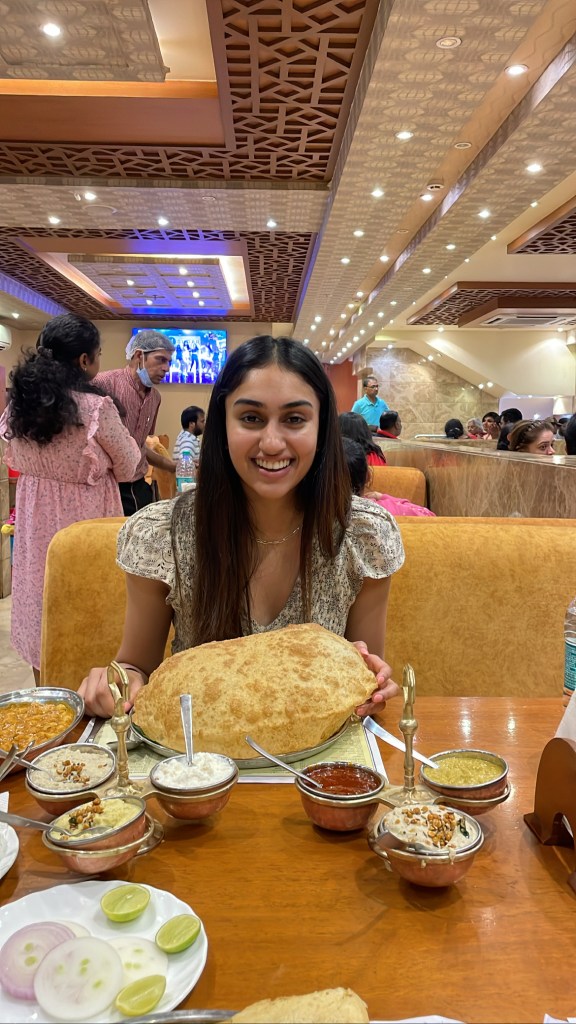
However, once I met my two good friends from Hyderabad, they introduced me to a whole new side of the city. They showed me a side of Hyderabad where true & hardcore friendships are created. Friendships seem so different here and I know other NRI humans, like coffee date #20, agree. The friendships here feel like the ‘life or death’ kinda bonds, where friends will actually move mountains to look after you. It’s a comforting feeling. They also introduced me to the lavish side of Hyderabad. The restaurants are truly exquisite. They’re filled with boujee interior and food, making it impossible to walk in with sweats and a tee. The live Telugu music is the cherry on top because it’s impossible to not bop to the music due to the band’s supreme talent. 

Though I LOVED Hyderabad, there were still some things that shook me to some extent. There’s a strong class divide in the city. There is an evident area of the city where the less privileged live compared to the more privileged. The more privileged or richer side of the city is filled with elite stores, restaurants, salons, designer places, and other luxuries that the other side has none of. Hell, even the roads are different.

It just felt like money and power were everything. With money, I was able to sit in the VIP area of the movie theater. With money, I was able to get the most elite treatment at one of the top salons in the city. With money, I was greeted differently by the employees of stores and restaurants. There was too much emphasis on financial wealth and power.

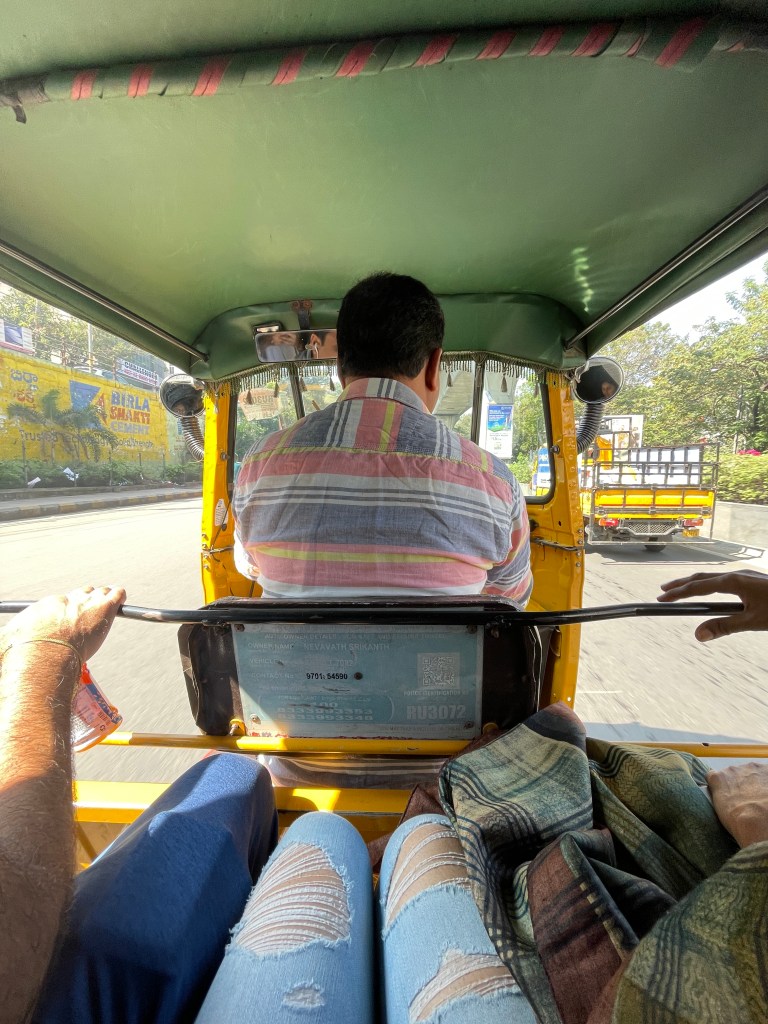
In general, India is home. It’s where my parents and grandparents were born and raised. It’s where my ancestors have thrived. It’s where the color of my skin is not a zone of judgment. It’s where my love for kurtis is not seen as a ‘cultural outfit’ – it’s just normal. It’s where the honking of the cars, bikes, and autos continuously ring in your ears. It’s where the touch of your elders gives you goosebumps as you realize that they’re actually proud of you. It’s where unbreakable friendships form. It’s a place of belonging – a place to call home. 

I am currently feeling that feeling where you have the most exquisite time during vacation or somewhere away from your normal life, where you feel the real ‘highs’ and once you come back you just feel really ‘low,’ as if you’re missing something, a piece of you. Maybe that piece of me is still in India, which is surely a sign for me to return again. 

Phir Milenge // See You Soon

This post was originally published on https://eshainbalashram.blogspot.com/.

I truly cannot believe that I’m back in my Jersey home and have completed my 15 days at Bal Ashram. I remember when I sat in the car for 2 hours, driving from the Jaipur airport to Bal Ashram, I was riddled with anxiety. Will the kids like me? How will the kids be? Will they be angry or will they ignore me? What is my purpose? Who am I and why am I even worthy of visiting the Ashram? Will the staff and faculty feel awkward about my arrival? So many questions and thoughts that were instantly hushed by the warm welcome of the staff, faculty, and most importantly, the children. 

I went to bed that first day realizing that this had been a dream of mine since my childhood days. I’ve always wanted to help children in any way I can and protect them as well as I can. It took me more than a decade to live out my dream and now I am filled with so many different emotions as I reflect on my time at the Ashram.

I want to take note of some things/moments I will forever hold in my heart:

  • Sunrises & Sunsets. I now have a weird obsession with the sun. Almost every day at the Ashram I had the incredible ability to witness both the sunrise and the sunset. Breathtaking. I hope I can continue to witness the sun’s glory here at home because it has been such a huge constant at Bal Ashram that I’ve grown to cherish.
  • The ‘Esha Didi’s. I will most definitely miss hearing all of the ‘Esha Didi’s. I’ll miss the suffocatingly pure and soul-filling effects of the children huddling around me and yelling my name in my face to get my attention. 
  • Chai & Biscuits. Masala chai is a fan favorite at Bal Ashram. They drink it every morning and around 4:00pm every day. I’ve grown to LOVE the taste of chai in combination with the Ashram’s Tiger Biscuits. The process of dipping the biscuit in the chai and then letting it melt in your mouth followed by a sip of the warm chai has been something I’ve grown to love. It’s also one of the most amazing ways to socialize at Bal Ashram. The staff and faculty sit on the stairs or inside the dining hall and take a few minutes to mingle with each other before they have to get back to their duties of teaching and supervision. 
  • Nature and music heal. Bal Ashram is located at a very scenic area, surrounded by mountains, occupied by plants and trees, and covered in a sand floor. All your senses are activated from the time you wake up: the chilling breeze coming down from the mountains, the clear view of the sunrises and sunsets, the feel of the cool tiles against your barefoot in the halls, the smell of the flowers growing on the trees. Bal Ashram has deepened my already existing love for nature. Music also plays a large role in the therapeutic atmosphere of Bal Ashram. Their daily prayers, slogans, chants, and meditations are so spiritually activating.
  • Never be afraid to party! These boys know how to party it up. They dance with so much passion and ‘kushi’ that you can’t help but groove with them. They taught me the dance to one of their Rajasthani songs and they even had a choreographed dance for ‘Jai Ho.’ IT WAS AMAZING! I taught them how to shake their hips (i.e. ‘thumka’) and give each other the hip hits because obviously that’s the classic Bollywood move everyone must know 🙂 
  • The Squiggle Technique. What a godly technique that left me in awe. This technique truly shows how much of our outer selves we hide/mask to fit our societal roles. It brings out our true inner feelings and subconscious thoughts that we often may try to suppress. 
  • Ladoos. While I was teaching a class on emotions one day, one of the boys started laughing hysterically. When I asked him what he was laughing at, he pointed at my cheeks and said ‘ladoo.’ I couldn’t help but crack a smile as I realized that he was referring to my chubby little cheeks that make an appearance every time I laugh wholeheartedly. I have now grown to love my cheeks thanks to that boy 🙂
  • Education is not a privilege – it’s a right. As of right now, education is a privilege for many of us when it really should be a right for ALL of us. One of the boys came up to me one day and said ‘You’re rich people and we’re poor people.’ I tried to explain to him that that is not true and money and living in the U.S. does not mean you’re better or ‘richer’ than anyone else in the world. However, he defined ‘richness’ as ‘being able to do and study whatever you want’ and that rocked me to my core. It’s true – I have the privilege to decide what education I want to receive and what future profession I want to enter. The boy told me that he doesn’t have that same option because he needs to study something specific that will make sure he gets a good job and enough money to then help his family come out of poverty. What an enormous burden to bear at such a young age. Going to school for me felt and looked so very different from what it looks and feels like for all of these children. 
  • Feminism in rural parts of the world. I already wrote about this previously, but I wanted to bring it up again to talk more about the gender divide. Opposite the Bal Ashram is a place called the Ballika Ashram, where teen girls come to learn sewing and beautician-related courses in an effort to get a job and become financially independent. During one of the celebrations, the Ballika Ashram girls came to the Bal Ashram to partake in the dances. I noticed that the boys and the girls would take turns dancing – they would never mix. The DJ would play some high-beat songs for the boys to dance to for 10 minutes and then he would switch to some low-beat and more elegant songs for the girls to dance to. When the girls arrived on the dance floor, the boys would move away and watch the girls, and vice versa. When I asked one of the boys why everyone isn’t dancing together (like I did with all of the boys and male staff/faculty the night before), the boy very confidently said “because when all boys and girls dance together, the boys dance with so much power that they might hit the girls and hurt them by accident.” I couldn’t help but to laugh at the internalized cultural sexism that still exists to this day. 
  • The 3 Musketeers. These three boys – V, L, and K – played a pretty large role at my time at the Ashram. They were older boys, around the age of 16-18, who are best friends with each other. I’ve heard and have been told directly by them that they don’t really interact with any of the staff, faculty, or even volunteers who visit the Ashram. However, they somehow felt comfortable enough with me and became a constant during my time there. These 3 best friends even collectively drew me a painting and gave me a tie-dye bracelet that says “Friend Forever” that I plan on wearing until it breaks open. I think the reason why I became so emotionally attached to these boys was because they made me feel like me being myself was enough. They gave me the space to open up and be completely myself and they accepted that part of me with so much love. 
  • The U.S. is seen as this almighty country. I agree that there are countries, like the U.S., with more resources and privileges compared to other countries. However, that does not make the people of that country better than anyone else. A lot of the boys have this internalized idea that Americans or even foreigners are superior to Indians. I don’t blame them because this has a lot to do with the centuries of the British oppression of India that may cause many to still believe that ‘white people’ or those who live in lands largely occupied by ‘white people’ are superior to others. 
  • The food! The cook, Ganesh Ji, is so insanely talented. Literally every single meal was stupendous, amazing, and incredibly filling. His paneer and puri combination was out of this freaking world!
  • The ‘Namaste Didi’s. The norm at the Ashram is to greet everyone, including the boys, with ‘Namaste’s instead of ‘Good Morning’ or ‘Hello.’ I will truly miss those early morning ‘Namaste Didi’s, where the boys would fold their hands around their chai cups and greet me with such kind smiles and eyes as they would walk me to their daily morning meet-up spots. 

The boys taught me a lot about life – too many to count, but I’ll attempt to list the main lessons. 

  • Love & presence is enough. Throughout my time at Bal Ashram, I was continuously riddled with self-doubt and guilt. Well-accomplished and distinguished leaders & talents from across the world visit Bal Ashram and then here I am, a super normal 20-year-old college gal who came from the U.S. I didn’t even have a degree to back me up! Who was I and why was I here? I wanted to just help in any way I can and I found that the ‘help’ that the boys wanted was a sense of belonging and love, so I tried my absolute best to give each and every one of them just that. I let myself open up and created a space where the boys saw me as an equal. During all their meditations and meetings, I would sit beside them instead of on a chair alongside the teachers. During their play time, I would play with them. During their movie times, I would sit for the entirety of the 2 hours and watch the whole film with them (and allowed for some to even use me as a human pillow). I gave them the space to feel comfortable enough to open up about their worries whenever they wanted to. Thus, I later realized that they didn’t need to know (or even cared about) whether or not I had a degree or if I conquered the world in some way or the other. They just wanted a companion and someone who could help them see themselves for who they are and remind them that they are all extremely talented & worthy boys. 
  • Trauma looks different for everyone. I knew that this was a fact, but I got to actually see it at the Ashram. One boy imagines a lot of things from his past due to his traumatic background. Another kid refuses to feel anger or recall his past, suppressing all of his feelings and festering up anger. Another kid feels so extremely lonely and has told me that he feels like his younger siblings have forgotten about him because he hasn’t seen them in years. Trauma is not comparable. Everyone’s trauma is trauma and thus, therapy & the healing process must also be tailored according to the needs of each individual child.  
  • What home is for some is an unknown place for others. Many of the boys remember where their homes are, but do not recall their homes being a safe space. Others reminisce about their past moments with their siblings and parents and feel lost as to why they ended up at the Ashram. Some are excited to be heading back to their homes and seeing their families after months. Home: it’s more-so a feeling than it is a place. 
  • Keep your inner child alive. Always. The children of Bal Ashram taught me to keep my inner child alive at all costs. I haven’t been that carefree & happy in so long! Keeping my inner child alive helped me become more spontaneous, ‘forgive & forget’ more easily, and made me enjoy life and its little offerings with much more ease.  

Coming back to my house in Jersey now feels a bit disorienting. I miss the ambience of the Ashram and the love from the boys. I know for a fact that I will see them again in the near future, so this isn’t a goodbye, just a ta-ta for now. Phir milenge boys 🥺

dear diary, currently: feeling small and inadequate.

I am currently living at the Bal Ashram in Jaipur, Rajasthan. I am a 100 Million U.S. Campaign intern and the foundation that that campaign is a part of runs this Ashram, which is a long-term rehabilitation center for boys rescued from child labor & trafficking. I’ve been living here for a week, teaching children about emotional well-being and doing one-on-one sessions with other boys who have learning disabilities. I only have one more week to go 😦

I realized that I’ve become rather possessive of these boys. I just want to squeeze all of them into my pocket and take them away with me. At the same time, I feel like I haven’t been doing enough for them. I don’t know any of the legal matters or policies regarding child labor. I am not a licensed therapist. I am also not a certified teacher. I don’t know who I am and what I can offer these children other than just my presence. And I don’t know if my presence is enough.

I want to be able to fix their lives and take them back to a stable household. I want to be able to fight for their rights in court. I want to help them psychologically. I feel like I am running out of time, but I know that’s false. However, it’s hard to continuously fight against your own thoughts.

One of the volunteers I met here, Julia (aka my next coffee date), told me that when working with children like these, we just have to keep reminding ourselves that we are enough, we are doing enough, and our work does have meaning.

I want to take it easy in 2023 and not put a timeline on my passions; I want to let my passions guide me, instead of the societal construct of a certain timeline. I don’t want to compare my passions and work with other people who may have similar interests. Everyone works at their own pace and in their own way. I want 2023 to be the year where I pursue my passions and relentlessly stand up for myself and the causes that I support.

Welcome 2023.